



















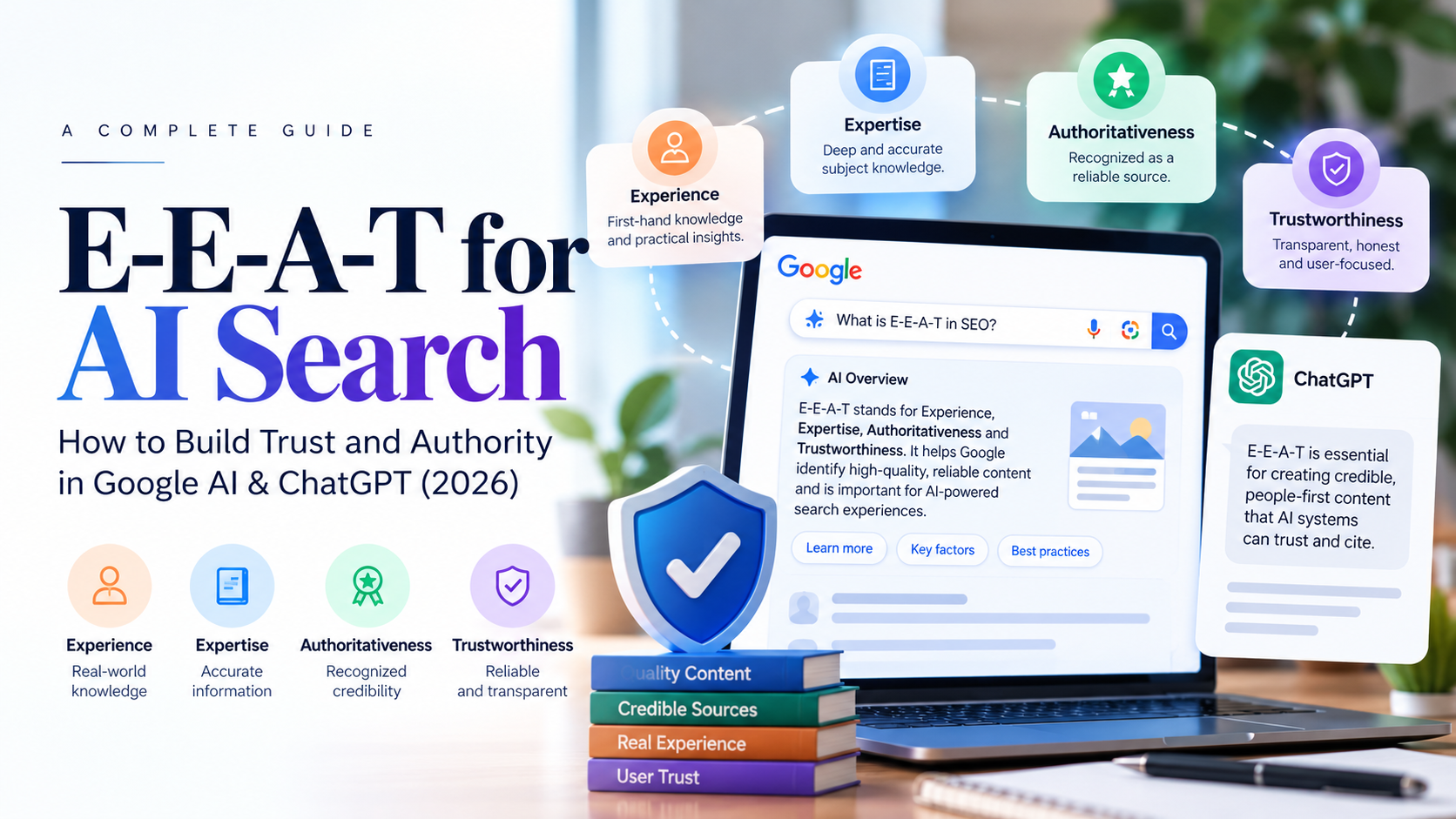
E-E-A-T for AI Search: How to Build Trust and Authority in Google AI & ChatGPT (2026)
E-E-A-T for AI Search is becoming an important consideration for businesses that want to build credibility and create useful content for Google AI Search and other AI-powered platforms.
Search visibility is no longer just about ranking a webpage for a keyword. Businesses also want their content to be discovered, referenced and trusted when people use AI-powered search experiences.
Google AI Overviews, Google AI Mode and conversational AI platforms have changed how users research products, compare services and find answers. In this environment, publishing more content is not necessarily the best way to improve visibility. The quality, credibility and usefulness of that content matter.
This is where E-E-A-T for AI Search becomes important.
E-E-A-T stands for Experience, Expertise, Authoritativeness and Trustworthiness. Google uses these concepts within its broader approach to evaluating helpful, reliable content. Although E-E-A-T is not a single ranking factor, Google’s guidance explains that its systems use multiple signals to identify content that demonstrates these qualities.
For businesses investing in AI SEO, the practical goal is clear: create content that genuinely helps people, demonstrates relevant knowledge and gives readers good reasons to trust the information.
In this guide, we explain what E-E-A-T means, how it relates to AI Search, and how businesses can build stronger credibility across their websites and digital presence.
What Is E-E-A-T for AI Search?
E-E-A-T for AI Search is the practice of demonstrating real experience, relevant expertise, recognized authority and trustworthiness through your website content and wider online presence.
The concept builds on Google’s established content-quality guidance. It is not a separate AI ranking formula, nor is there a special E-E-A-T score that guarantees visibility in Google AI or ChatGPT.
Instead, it provides a practical framework for creating content that deserves to be discovered and used by people.
Consider two articles about choosing an SEO agency.
The first contains generic advice, broad claims and no evidence of practical experience.
The second explains how to evaluate an agency, discusses realistic campaign limitations, provides a transparent measurement framework and demonstrates relevant experience.
The second article gives readers more useful information and stronger reasons to trust the publisher.
That is the difference businesses should aim for when improving their content quality.
Google’s official guidance on helpful, reliable, people-first content explains how experience, expertise, authoritativeness and trust contribute to content quality. Trust is the most important element of the framework.
Why Does E-E-A-T Matter for AI Search in 2026?
AI-powered search systems can synthesize information from multiple sources to answer a user’s question. Google’s guidance explains that its generative Search features build on its existing Search index and core ranking and quality systems.
This means traditional SEO remains relevant, but publishing generic content simply to target keywords is a weak long-term strategy.
Businesses should focus on creating information that is useful, distinctive, accurate and supported by appropriate evidence.
Here are four reasons to strengthen E-E-A-T.
1. Users Need Reliable Information
People may use AI Search to compare service providers, research products, understand technical issues or evaluate important decisions.
They need information that is accurate and presented with appropriate context.
A website that clearly identifies its authors, explains its services, cites reliable sources and avoids exaggerated claims gives visitors more reasons to trust it.
2. Original Insights Differentiate Your Content
Many websites publish similar articles covering the same basic advice.
For example, hundreds of blogs might explain what SEO is. Far fewer provide original campaign observations, practical implementation examples, transparent reporting methods or detailed explanations of what did not work.
Google’s guide to optimizing for generative AI Search emphasizes creating unique, valuable, non-commodity content.
Your objective should be to add something useful that readers cannot easily get from another generic article.
3. Clear Expertise Helps Readers Evaluate Your Business
A business website should explain what the company does, whom it serves and why its experience is relevant.
For a digital marketing agency, that might include service-specific expertise, transparent processes, original analysis, case studies and clearly explained campaign methodologies.
For a healthcare provider, it may include accurate professional credentials, reviewed educational content and appropriate medical references.
The evidence should fit the subject and the level of expertise required.
4. Trust Extends Beyond a Single Blog Post
Readers may evaluate a business through its website, author information, company profile, reviews, professional profiles and other credible sources.
These touchpoints should tell a consistent story.
However, there is no guarantee that collecting mentions or reviews will cause an AI system to cite a particular business. Focus on building genuine credibility rather than manufacturing signals.
Understanding the Four Elements of E-E-A-T
Experience: Demonstrate First-Hand Knowledge
Experience refers to knowledge gained through direct involvement with a subject.
Instead of simply repeating standard advice, show how a process works in practice.
For a digital marketing agency, this could include:
- Anonymized campaign examples with appropriate context.
- A walkthrough of a real SEO audit.
- Screenshots of reporting dashboards, with sensitive information removed.
- Lessons learned from implementing website improvements.
- Before-and-after comparisons supported by verifiable data.
For example, an article about improving landing-page conversions could explain the changes tested, the measurement period and the limitations of the findings.
Do not invent client results or imply that a test was performed when it was not.
Practical tip: Add one genuine example, observation or original insight to every major article where you have relevant experience to share.
Expertise: Explain the Subject Accurately
Expertise is demonstrated by the depth, accuracy and relevance of the information you provide.
A useful article should answer the reader’s question clearly while explaining important details, limitations and next steps.
To demonstrate expertise:
- Cover the topic thoroughly without unnecessary repetition.
- Explain technical concepts in accessible language.
- Reference reliable primary sources where appropriate.
- Distinguish established facts from estimates or opinions.
- Keep time-sensitive information updated when necessary.
- Have qualified professionals review specialist content when appropriate.
For complex subjects such as healthcare, law or finance, use appropriately qualified reviewers and authoritative references.
Expertise should be demonstrated through the quality of the work, not simply claimed in a headline.
Authoritativeness: Establish Recognition in Your Field
Authoritativeness concerns the recognition a person, organization or website earns within its area of expertise.
A single article rarely establishes this by itself. Businesses can build authority over time by consistently publishing useful material and developing a clear topical focus.
For Digital Corn, a practical approach is to create a connected library of resources around SEO, AI Search, website optimization, digital advertising and related business challenges.
For example, your AI Search content cluster can cover:
- AI SEO fundamentals.
- Generative Engine Optimization (GEO).
- Answer Engine Optimization (AEO).
- Google AI Overviews and AI Mode.
- Schema markup and technical SEO.
- AI Search measurement.
- Multimodal SEO.
- Agent-friendly website optimization.
Link these articles together where the connection genuinely helps readers.
Also strengthen your brand’s broader credibility through original research, relevant professional contributions, transparent company information and legitimate industry references.
Remember: publishing many articles is not automatically proof of authority. The depth, accuracy and usefulness of the content matter.
Trustworthiness: Make Your Website Credible
Trustworthiness is the foundation of E-E-A-T.
Readers should be able to understand who operates the website, where important claims come from and how to contact the business.
Review these elements:
- Accurate company information.
- Clear contact details.
- Author biographies and relevant credentials.
- Reliable citations for factual claims.
- Transparent service descriptions.
- Honest testimonials and case studies.
- Secure website connections.
- Clear privacy and other applicable policy pages.
- Accurate pricing and terms wherever relevant.
Avoid fabricated reviews, misleading credentials, unsupported guarantees and exaggerated performance claims.
For service businesses, transparency about what is included, what results depend on and what cannot be guaranteed is an important part of building trust.
10 Ways to Improve E-E-A-T for AI Search
Understanding the concept is useful, but implementation is what makes the difference. Use the following framework to improve the quality and credibility of your website.
1. Add Author Information to Important Articles
Readers should be able to identify who wrote or reviewed a piece of content.
Where appropriate, include:
- Author name.
- Relevant professional background.
- Subject expertise.
- Link to an author profile.
- Reviewer details for specialist content.
Keep every credential accurate. Do not create fictional author profiles to make content appear more authoritative.
2. Publish Original Case Studies
Case studies demonstrate how your expertise is applied.
A useful case study explains the business challenge, the approach taken, the work completed and the results observed.
Include relevant context such as the reporting period, the metrics measured and any important limitations.
For example, a digital marketing case study could explain how technical SEO improvements affected organic impressions over a defined period.
Do not attribute all growth to one change when multiple factors contributed.
3. Create Content That Goes Beyond Generic Advice
Before publishing an article, ask:
What does this page provide that an ordinary summary does not?
Possible additions include:
- Original analysis.
- Practical examples.
- A useful checklist.
- A decision-making framework.
- Expert commentary.
- An implementation walkthrough.
- Lessons from genuine experience.
Avoid producing multiple near-identical articles that only change the keyword or industry name.
4. Cite Reliable and Relevant Sources
Support factual claims with credible references.
For Google Search guidance, prioritize official Google Search Central documentation. For industry statistics, use the original report or research publication wherever possible.
Make sure citations support the claims attached to them.
A long reference list does not automatically make an article reliable. The sources must be relevant, accurate and used in context.
5. Build a Clear Website Structure
Organize your content so users can discover related information easily.
For example, a digital marketing website could structure its resources into clear topics such as:
- SEO and technical SEO.
- AI Search and content optimization.
- Paid advertising.
- Social media marketing.
- Website development.
- Industry-specific digital marketing.
Use descriptive navigation, relevant internal links and clear page titles.
This improves usability and helps search systems understand the relationships between your pages.
6. Keep Business and Author Details Consistent
Check that your business name, contact details, service descriptions and professional information are accurate wherever you publish them.
For local businesses, review the consistency of important details across the website and relevant business profiles.
Correct outdated information rather than creating more profiles simply to increase the number of mentions.
7. Review Your Content Regularly
Outdated advice can undermine trust.
Create a review process for articles that contain changing information, such as platform features, pricing, regulations, product specifications or statistics.
During an update:
- Verify the important claims.
- Replace outdated references.
- Correct inaccurate examples.
- Add meaningful new information.
- Update the visible publication or modification date when appropriate.
Do not change dates simply to make an unchanged article appear fresh.
8. Make AI-Assisted Content More Useful
AI tools can support research, outlining, editing and content production. But the final article still needs to meet your quality standards.
Use AI to assist with the workflow, not to replace fact-checking or genuine expertise.
Before publishing, review:
- Factual accuracy.
- Source quality.
- Originality.
- Relevance to your audience.
- Unsupported claims.
- Repetitive or generic sections.
- Whether the content provides real value.
Google’s guidance focuses on the quality and purpose of content rather than treating AI assistance alone as the deciding factor.
If readers would reasonably want to know how specialist content was produced, provide appropriate transparency.
9. Improve Your Website’s Technical Foundations
Credible content also needs to be accessible.
Check that important pages can be crawled and indexed, internal links work correctly and essential information is not unnecessarily hidden behind inaccessible interactions.
Maintain accurate titles, canonical URLs, sitemaps and appropriate structured data.
Structured data can help search engines understand page information and qualify pages for supported search features. It does not guarantee AI citations or improve E-E-A-T by itself.
10. Demonstrate Trust Through the Entire Customer Journey
Trust is not limited to blog content.
Review the full experience from discovery to conversion.
Can a visitor understand your services, compare options, find contact information and understand what happens after submitting an enquiry?
Make forms clear, explain your process, communicate limitations honestly and provide accessible ways to contact your business.
A website that makes it easy for people to evaluate and engage with a business supports credibility beyond the blog itself.
How to Apply E-E-A-T to Digital Corn’s AI Search Strategy
For Digital Corn, E-E-A-T should become part of your existing AI Search content strategy rather than another disconnected series of blogs.
Strengthen Your Existing AI Search Articles
Review your published articles on AI SEO, GEO, AEO, Google AI Overviews, schema markup, AI Search visibility, multimodal SEO and agent-friendly SEO.
For each article, check whether it contains:
- Accurate and current information.
- Relevant primary-source references.
- A clear explanation of the topic.
- Useful implementation advice.
- Examples that genuinely add value.
- Relevant internal links.
- Clear authorship and company information.
Do not rewrite every article merely to add the term E-E-A-T. Improve the actual evidence, usefulness and credibility of the content.
Create a Strong Author and Company Profile
Make it easy for readers to learn about Digital Corn, its services and the people responsible for its work.
An effective company profile should explain the agency’s capabilities, its approach to digital marketing and the types of business challenges it helps solve.
Author profiles should accurately describe each person’s role and relevant expertise.
Connect Educational Content With Services
Your blog should help readers move naturally from learning about a topic to understanding how Digital Corn can help.
For example, an article about AI Search optimization can link to a relevant SEO service page. A technical SEO guide can link to website optimization services.
Use contextual links that match the reader’s needs rather than adding promotional links to every paragraph.
Show Your Work
Where client permissions allow, publish case studies, practical demonstrations, original observations and transparent reporting examples.
If client data is confidential, use anonymized examples only when they are accurate and cannot mislead readers.
The goal is to demonstrate capability through evidence rather than relying on broad statements such as “we are the best digital marketing agency.”
Does E-E-A-T Directly Improve AI Search Rankings?
There is no standalone E-E-A-T score that guarantees a page will rank in Google Search or appear in an AI-generated answer.
Google explicitly states that E-E-A-T itself is not a specific ranking factor. Its systems use a variety of signals to identify helpful, reliable content, with trust playing a central role in the E-E-A-T framework.
Google also explains that generative AI Search builds on its existing Search systems and SEO fundamentals.
Therefore, the sensible approach is not to optimize for a supposed E-E-A-T score. Instead, improve the real qualities the framework represents: experience, expertise, authority and trust.
Visibility in AI platforms can vary by query, source availability, location, time and platform. Strong content quality improves the foundations of your strategy, but it cannot guarantee a citation or recommendation.
How to Measure Your E-E-A-T Improvements
E-E-A-T is not measured through one universal dashboard metric. Track practical indicators that help you understand whether your content and website are becoming more useful and credible.
Content quality
- Number of important articles reviewed and improved.
- Accuracy and relevance of sources.
- Presence of original examples and evidence.
- Completion of author and reviewer information.
Organic search performance
- Search impressions and clicks.
- Relevant non-branded queries.
- Organic traffic to key resources.
- Conversions from organic landing pages.
AI Search visibility
- Relevant brand mentions and citations across selected AI platforms.
- Pages cited for important topic areas.
- Changes in visibility across repeated tests.
- Referral traffic from AI platforms, where measurable.
Business outcomes
- Qualified enquiries.
- Conversion rates.
- Leads influenced by educational content.
- Engagement with relevant service pages.
Use Google Search Console and your analytics platform for the metrics they support. For third-party AI visibility tools, treat results as estimates or observations rather than definitive access to a platform’s internal ranking system.
Review results over time rather than relying on a single search or one-off AI response.
E-E-A-T for AI Search: Practical Checklist
Use this checklist when reviewing your website.
Experience
Include genuine examples where relevant.
Publish accurate case studies.
Explain real processes and lessons learned.
Expertise
Identify qualified authors or reviewers where appropriate.
- Verify important claims.
- Explain complex topics accurately.
- Use reliable primary sources.
Authoritativeness
- Build a coherent topical content cluster.
- Link related articles naturally.
- Publish original insights.
- Develop legitimate professional and industry recognition.
Trustworthiness
- Keep company and contact information accurate.
- Provide clear author information.
- Avoid fabricated testimonials and unsupported guarantees.
- Maintain transparent policies and service information.
Technical SEO
- Ensure important pages are crawlable and indexable.
- Review internal links and canonical URLs.
- Maintain relevant structured data.
- Monitor Search Console and analytics.
Final Thoughts
E-E-A-T for AI Search is not about finding another shortcut to rankings. It is about building a website that demonstrates why its information deserves attention and trust.
For businesses in 2026, that means moving beyond generic, keyword-focused publishing and investing in useful content, real experience, relevant expertise, transparent business information and reliable technical foundations.
For Digital Corn, the opportunity is to connect your existing AI Search content cluster with stronger evidence of expertise and a more consistent user experience.
Create content that demonstrates what you know, supports what you say and genuinely helps your audience make better decisions.
That is a more sustainable foundation for organic visibility and AI Search discovery.
Frequently Asked Questions
What is E-E-A-T in SEO?
E-E-A-T stands for Experience, Expertise, Authoritativeness and Trustworthiness. Google uses these concepts within its broader framework for evaluating helpful and reliable content. E-E-A-T itself is not a standalone ranking factor.
Does E-E-A-T matter for AI Search?
E-E-A-T is relevant to content quality in AI Search because Google’s generative Search features build on its core Search and quality systems. Demonstrating genuine expertise and providing useful, trustworthy information are sensible foundations for AI SEO.
How can a website demonstrate E-E-A-T?
A website can demonstrate E-E-A-T through accurate content, genuine first-hand examples, qualified authors, reliable references, transparent company information, original research and useful case studies.
Is E-E-A-T a direct Google ranking factor?
No. Google says E-E-A-T itself is not a specific ranking factor. Its automated systems use multiple signals to identify helpful, reliable content.
Does adding author bios improve AI Search visibility?
Accurate author bios help readers understand who created content and what relevant expertise they have. They are useful for transparency, but adding a bio alone does not guarantee better rankings or AI citations.
Does AI-generated content hurt E-E-A-T?
AI assistance does not automatically make content untrustworthy. The important considerations are whether the content is accurate, useful, original where appropriate and created primarily to help people rather than manipulate rankings.
How often should E-E-A-T content be updated?
Review content when facts, guidance, platform features or business information change. Prioritize meaningful corrections and improvements instead of changing dates without making substantive updates.
How does E-E-A-T differ from GEO?
GEO, or Generative Engine Optimization, is a term used for improving content visibility in generative AI experiences. E-E-A-T is a framework for evaluating qualities associated with helpful and trustworthy content. They overlap in practice, but they are not the same concept.
STAY IN THE LOOP