












What Is Answer Engine Optimization (AEO)?
Search is no longer limited to typing keywords into Google and choosing a link.
Today, users increasingly ask complete questions such as:
“Which digital marketing agency is best for a growing business?”
“How can I improve my website’s visibility in AI search?”
“What is the best way to generate leads through Google Ads?”
Instead of browsing several pages, users increasingly expect a direct, useful answer.
This shift has created a new area of search optimization called Answer Engine Optimization (AEO).
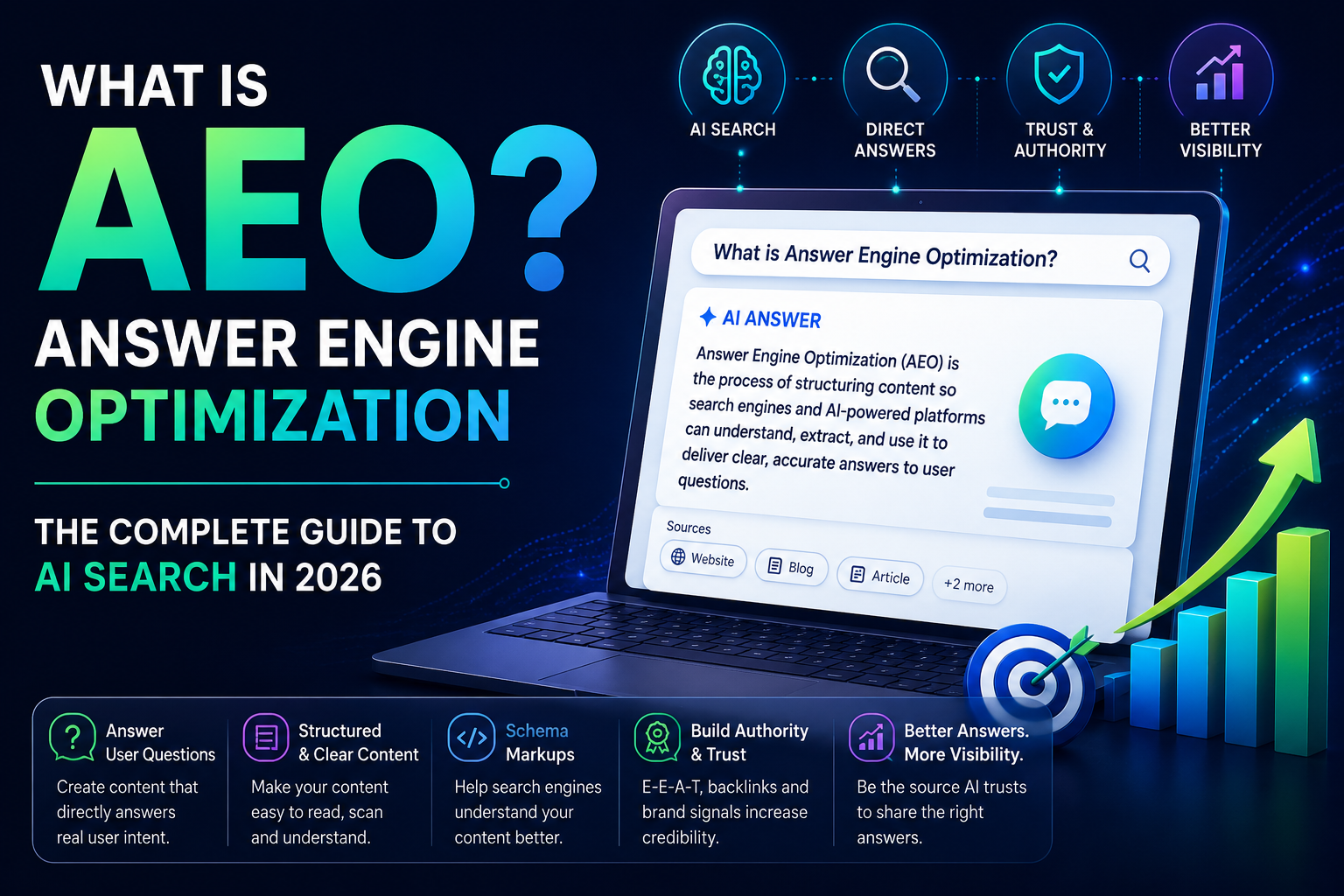
Answer Engine Optimization is the practice of structuring your content, website, and digital presence so that answer-focused search experiences can understand your information and potentially use it when generating answers.
It works alongside traditional SEO and newer AI-search approaches such as Generative Engine Optimization (GEO).
What Is Answer Engine Optimization (AEO)?
Answer Engine Optimization (AEO) is the process of creating and structuring content so it can provide clear, direct answers to the questions users ask across search engines and AI-powered answer experiences.
The objective is not simply to rank a webpage.
The objective is to make your information:
- Easy to understand
- Easy to extract
- Relevant to the query
- Supported by evidence
- Clearly structured
- Trustworthy
- Useful to the user
AEO is therefore closely connected to modern SEO, content strategy, structured data, and AI Visibility.
Why Is AEO Important in 2026?
The search journey is becoming more conversational.
Platforms such as ChatGPT can search the web and provide answers with links to relevant sources.
Google has also introduced AI-generated search experiences that can synthesize information from multiple sources.
This means businesses need to think beyond:
“How do I rank this page?”
and start asking:
“Does this page clearly answer the question my customer is asking?”
That change is at the heart of AEO.
AEO vs SEO vs GEO
These terms overlap, but they emphasize different parts of modern search.
| SEO | AEO | GEO |
|---|---|---|
| Search Engine Optimization | Answer Engine Optimization | Generative Engine Optimization |
| Focuses on search visibility | Focuses on answer visibility | Focuses on generative AI visibility |
| Targets rankings and organic discovery | Targets direct answers and extractable information | Targets AI-generated responses and citations |
| Keywords and search intent matter | Questions and clear answers matter | Context, authority and source selection matter |
| Technical SEO remains important | Content structure is especially important | Entity and authority signals are especially important |
The strongest strategy is not choosing one over another.
It is building a system where SEO, AEO, GEO, and AI Visibility work together.
How Does AEO Work?
AEO starts with understanding what your audience actually wants to know.
For example, a traditional keyword might be:
An AEO-focused content strategy expands this into questions such as:
- What does a digital marketing agency do?
- How much does digital marketing cost?
- How do I choose a digital marketing agency?
- Which services should a startup invest in?
- What is the difference between SEO and paid advertising?
Each question represents a potential opportunity to provide a useful answer.
Your content should then answer those questions clearly and comprehensively.
10 AEO Strategies to Improve Your AI Search Visibility
1. Identify Real Customer Questions
Start with the questions your customers ask before, during, and after contacting your business.
Use:
- Google Search Console
- Search suggestions
- Keyword research
- FAQs from your sales team
- Customer support conversations
- Reviews
- Reddit and community discussions
- AI search queries
Don’t create content simply because a keyword has search volume.
Create it because someone actually needs the answer.
2. Give the Answer First
One of the simplest AEO improvements is to make the answer easy to find.
For example:
What Is AEO?
Answer Engine Optimization is the process of structuring content so search engines and AI-powered answer systems can understand and potentially use it to answer user questions.
Then explain the topic in greater detail.
This structure makes your content useful for both humans and machines.
3. Use Question-Based Headings
Instead of using generic headings, mirror the language your audience uses.
For example:
What Is Answer Engine Optimization?
How Does AEO Work?
Is AEO Different From SEO?
How Can Businesses Improve AEO?
Does Schema Help With AEO?
This creates a logical information structure around the user’s search intent.
4. Create Comprehensive Topic Clusters
One article shouldn’t have to answer every question about an entire industry.
Instead, build connected content.
For Digital Corn, your AI-search cluster can look like:
AI Visibility
↓
Generative Engine Optimization
↓
AI SEO
↓
Answer Engine Optimization
↓
Rank in ChatGPT
↓
Google AI Overviews
↓
Schema for AI Search
↓
AI SEO Checklist
Internal linking connects these resources and helps establish topical relationships.
5. Use Clear, Structured Content
Make important information easy to scan.
Use:
- Short paragraphs
- Descriptive headings
- Lists
- Tables
- Definitions
- Examples
- Step-by-step explanations
- FAQs
Research into generative search suggests that pages with strong structure and extractable evidence can have greater influence when they are selected as sources.
6. Support Claims With Evidence
Don’t simply say:
“Our strategy increases conversions.”
Explain:
- What was changed
- Why it was changed
- What was measured
- What happened
- What businesses can learn
Original research, case studies, examples, and transparent methodology make content more useful and credible.
7. Strengthen Your Brand Entity
AEO isn’t only about individual blog posts.
AI systems need to understand who you are.
Make sure your website clearly communicates:
- Company name
- Services
- Industry expertise
- Locations
- Team
- Authors
- Contact information
- Client work
- Company history
Your information should also remain consistent across reputable external platforms.
8. Implement Structured Data
Schema markup helps search engines understand the meaning and relationships within your content.
Depending on your page, consider relevant structured data such as:
- Organization
- Article
- Breadcrumb
- Service
- Local Business
- Product
- Review
Don’t add schema simply to add schema. It should accurately represent the visible content on the page.
9. Build Authority Beyond Your Website
Your website is only one part of your digital footprint.
Build credibility through:
- Industry publications
- Digital PR
- Expert interviews
- Podcasts
- Relevant directories
- Professional profiles
- Quality backlinks
- Customer reviews
A 2026 study comparing traditional search and generative AI found meaningful differences in the types of sources used by different search systems, reinforcing the importance of building authority beyond a single website.
10. Keep Your Content Updated
AI search is constantly evolving.
Information that was accurate last year may no longer be accurate today.
Review important pages regularly and update:
- Statistics
- Examples
- Screenshots
- Product information
- Industry developments
- Internal links
- FAQs
Don’t add “2026” to a title simply to make an article look fresh.
Actually update the information.
AEO Content Structure Example
Suppose you want to create a page targeting:
“What is AI SEO?”
A strong AEO structure could look like:
What Is AI SEO?
Direct answer
How Does AI SEO Work?
Explanation + examples.
AI SEO vs Traditional SEO
Comparison table.
Why Does AI SEO Matter?
Benefits and use cases.
How to Optimize a Website for AI Search
Step-by-step recommendations.
Common AI SEO Mistakes
Practical examples.
Frequently Asked Questions
Short, direct answers.
This structure is useful to readers while also making the page’s information easier to interpret.
Does FAQ Content Still Matter for AEO?
Yes, but don’t treat FAQs as a shortcut to AI visibility.
The purpose of an FAQ section should be to answer real questions your audience has.
For example, a digital marketing agency could answer:
- How much does SEO cost?
- How long does SEO take?
- Does SEO work with Google AI Overviews?
- What is GEO?
- What is AEO?
- Can my business appear in ChatGPT?
The answers should be accurate, concise, and supported by the rest of the website.
Common AEO Mistakes
Keyword Stuffing
Repeating a keyword dozens of times doesn’t make content more authoritative.
Focus on meaning, context, and user intent.
Writing Only for AI
Don’t make content robotic just because you want AI systems to understand it.
The primary audience is still the human reader.
Creating Hundreds of Low-Quality FAQs
More questions don’t automatically mean more visibility.
Create fewer, better answers.
Making Unsupported Claims
Avoid exaggerated statements such as:
“We can guarantee that your business will appear in ChatGPT.”
AI search results are dynamic and no legitimate agency can guarantee a specific AI citation or recommendation.
Ignoring Traditional SEO
AEO does not make technical SEO irrelevant.
Crawlability, indexability, site architecture, content quality, links, and user experience remain foundational.
How to Measure AEO Performance
AEO should not be measured only through traditional keyword rankings.
Track a broader set of signals:
Traditional SEO
- Organic impressions
- Organic clicks
- Rankings
- Indexed pages
- Backlinks
AI Visibility
- Brand mentions in AI answers
- Citation frequency
- Which pages are cited
- Which queries trigger mentions
- Referral traffic from AI platforms
- Branded search growth
Keep in mind that AI responses can vary between queries and over time, so a single test should not be treated as definitive proof of visibility.
AEO Checklist for Businesses
Before publishing an important page, ask:
- Does this page answer a real customer question?
- Is the answer clear near the beginning?
- Are the headings descriptive?
- Does the page provide original value?
- Are claims supported?
- Is the content easy to scan?
- Are related pages internally linked?
- Is relevant schema implemented correctly?
- Is the author or business expertise clear?
- Is the information current?
- Does the page provide a useful next step?
If the answer is yes to most of these, you’re building a stronger foundation for modern search.
How Digital Corn Can Help With AEO
At Digital Corn, we help businesses adapt their search strategy for the transition from traditional search to AI-powered discovery.
Our approach combines:
- Traditional SEO
- Answer Engine Optimization
- Generative Engine Optimization
- AI Visibility
- Technical SEO
- Content Strategy
- Schema Implementation
- EEAT Optimization
- Digital PR
- Website Optimization
The goal isn’t to chase a temporary AI trend.
It’s to build a digital presence that is easy to discover, easy to understand, and trustworthy enough to recommend.
Frequently Asked Questions
What is Answer Engine Optimization?
Answer Engine Optimization is the practice of structuring content and digital information so answer-focused search experiences can understand and potentially use it when responding to user questions.
Is AEO the same as SEO?
No. AEO complements SEO. SEO focuses broadly on search visibility, while AEO places greater emphasis on providing clear, direct, structured answers to user questions.
Is AEO the same as GEO?
Not exactly. The terminology overlaps across the industry. AEO generally emphasizes answer-focused experiences, while GEO is commonly used for optimization around generative AI responses.
Can AEO help my business appear in ChatGPT?
AEO can improve the clarity and usefulness of your content, which may support visibility in AI-powered search. However, no optimization technique can guarantee that ChatGPT or another AI platform will mention a particular business.
Does AEO replace traditional SEO?
No. The strongest strategy is to combine technical SEO, helpful content, authority building, AEO, and GEO rather than treating them as competing disciplines.
How long does AEO take to work?
There is no universal timeline. Results depend on your website’s authority, competition, content quality, technical health, and the AI/search platform being measured.
The Future of Search Is About Answers
Search is moving from links to answers.
But that doesn’t mean websites are becoming irrelevant.
The businesses that win in AI search will still need strong websites, expert content, credible sources, technical foundations, and recognizable brands.
The difference is that businesses now need to make their information useful not only for people browsing search results, but also for systems that synthesize information into answers.
That’s the opportunity behind Answer Engine Optimization.
Build useful answers.
Build authority.
Build trust.
And make your business easy to understand wherever your customers search.
STAY IN THE LOOP