
















Google Search is changing.
Instead of every search producing the same familiar list of blue links, Google can now use generative AI to help users explore complex questions, understand information and discover relevant websites.
Two of the most important experiences are:
Google AI Overviews
and
Google AI Mode
They are closely related, but they are designed for different types of search interactions.
For businesses and SEO professionals, understanding Google AI Mode vs AI Overviews matters because visibility in these experiences is becoming another part of the search journey.
Google says its generative AI features in Search are built on its core Search ranking and quality systems, meaning established SEO best practices continue to matter.
So, what exactly is the difference?
Let’s break it down.
What Are Google AI Overviews?
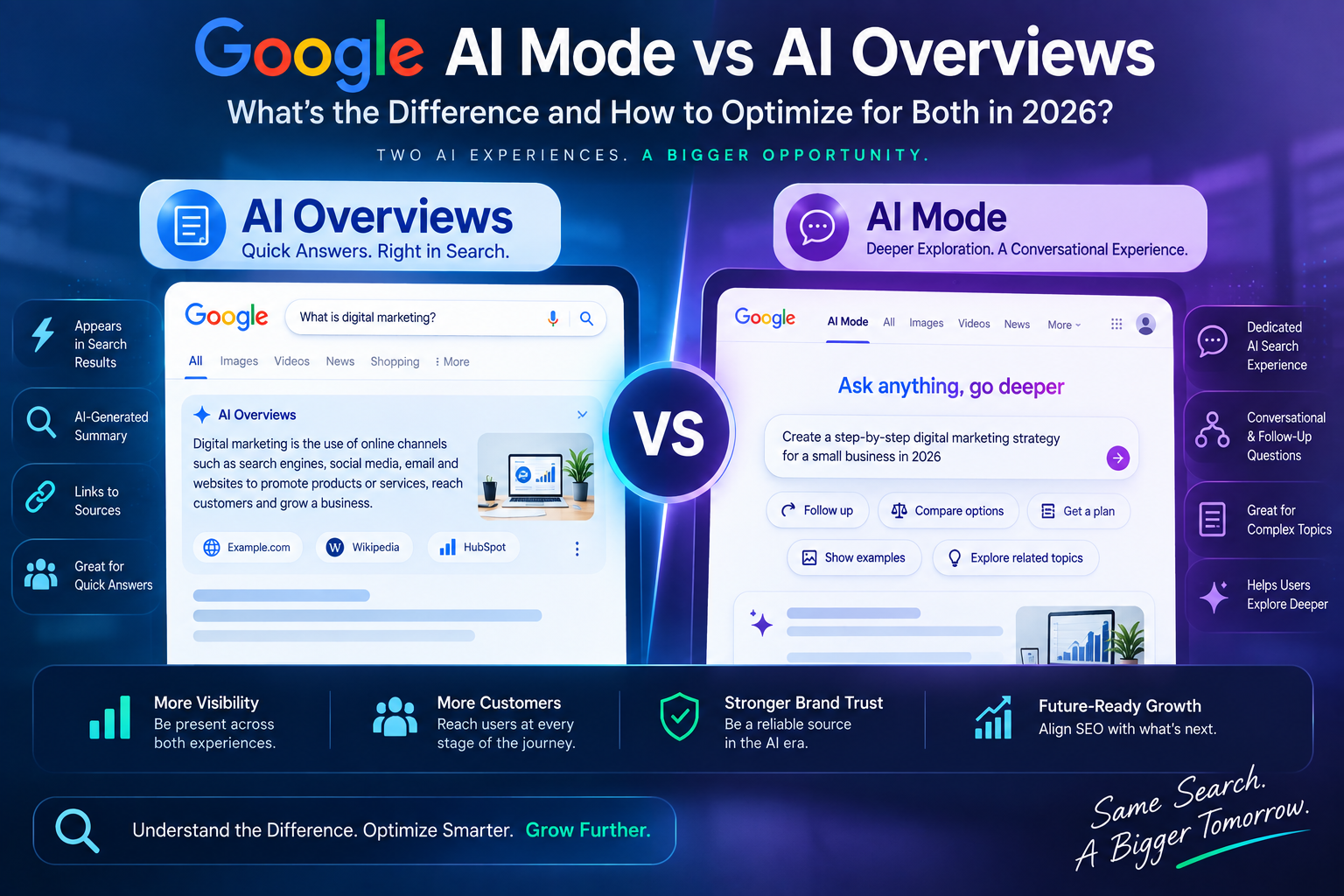
AI Overviews are AI-generated summaries that can appear within Google Search results for certain queries.
Instead of requiring users to open several websites before getting a basic understanding of a topic, Google can provide an AI-generated overview accompanied by links to supporting sources.
For example, someone might search:
“How does generative AI affect digital marketing?”
Instead of seeing only traditional organic listings, the search page may include an AI-generated overview summarizing key information and linking to relevant webpages.
Google describes AI Overviews as a way to help users explore topics while still connecting them with the broader web. Google has also introduced additional ways for users to discover original content and relevant websites within AI Search experiences.
In simple terms:
AI Overview = AI summary integrated into the traditional Search results experience.
What Is Google AI Mode?
AI Mode is a more conversational Search experience.
Instead of simply adding an AI summary to a conventional results page, AI Mode is designed for users who want to have a deeper, more exploratory interaction with Search.
Users can ask more complex questions, follow up on previous questions and explore a topic conversationally.
Google says AI Mode queries are significantly longer than traditional searches and that people are using the feature to ask questions that are more complex and harder to express through conventional keyword searches.
Google reported in May 2026 that AI Mode had surpassed one billion monthly active users globally and that AI Mode queries had more than doubled each quarter since launch.
In simple terms:
AI Mode = a deeper, conversational AI-powered Search experience.
Google AI Mode vs AI Overviews: The Key Difference
The easiest way to understand the difference is this:
| AI Overviews | AI Mode |
|---|---|
| Appears within Search results | Dedicated AI-powered Search experience |
| Provides an AI-generated overview | Designed for deeper exploration |
| Often complements traditional results | More conversational |
| Useful for quick understanding | Useful for complex questions |
| Can include supporting links | Can explore multiple related aspects |
| Traditional Search remains visible around it | AI interaction is the central experience |
These experiences overlap, but they aren’t identical.
Both are designed to help users discover information and websites through AI-assisted Search.
Why This Difference Matters for SEO
Historically, SEO conversations focused heavily on:
“What position does my website rank at?”
AI Search introduces additional questions:
- Is my website being surfaced in AI responses?
- Is my content being cited?
- Which pages are appearing?
- Which topics generate visibility?
- Are competitors appearing instead?
- Are users clicking through?
- Is AI Search generating meaningful business traffic?
Google has begun providing website owners with additional Search Console insights around appearances in generative AI Search features, including impressions and information about pages appearing in AI responses and countries. Google stated that this reporting had rolled out globally by August 31, 2026.
That means AI visibility is becoming increasingly measurable.
How AI Overviews and AI Mode Choose Information
There isn’t a publicly documented formula such as:
“Use this keyword 15 times to appear in AI Mode.”
Google’s current guidance instead emphasizes existing SEO fundamentals, useful content and providing information that offers real value rather than generic or commodity content.
That means businesses should focus on the fundamentals.
Your website should be:
- Crawlable
- Indexable
- Technically sound
- Useful
- Original
- Well structured
- Relevant to the searcher’s intent
- Supported by appropriate structured data
- Clear about who created the content
- Easy for users to navigate
1. Create Content That Answers Complex Questions
Traditional keyword targeting often looks like:
“AI SEO”
But AI Search users may ask:
“How can a B2B company optimize its website so AI-powered search engines can understand and cite its content?”
That’s a much more detailed information need.
Your content should therefore answer both:
Short questions
What is AI SEO?
and:
Complex questions
How does AI SEO differ from traditional SEO and what should a business change on its website?
This gives your content more depth.
2. Build Topic Clusters
One article shouldn’t have to answer everything.
Build connected content around a subject.
For example, Digital Corn‘s AI Search cluster can include:
AI SEO
→ GEO
→ AEO
→ ChatGPT visibility
→ Google AI Overviews
→ Google AI Mode
→ Schema Markup
→ AI-Ready Websites
→ E-E-A-T
→ AI SEO Checklist
→ AI Search Visibility
This structure allows users—and search systems—to discover related information across your website.
3. Write for Search Intent, Not Just Keywords
AI Search makes search intent even more important.
Consider these three searches:
Informational
What is AI SEO?
Practical
How do I optimize my website for AI Search?
Commercial
These should not lead to identical pages.
Create content based on what the user actually wants.
4. Give Direct Answers
Don’t bury the answer beneath five paragraphs of introduction.
For important questions, use a structure like:
What is Google AI Mode?
Google AI Mode is a conversational Search experience designed to help users explore complex questions through AI-generated responses and follow-up interactions.
Then expand.
This structure makes the page easier for humans to scan and understand.
5. Add Original Information
Google’s current AI Search guidance specifically highlights the importance of non-commodity content and original value.
Don’t simply rewrite:
“What is AI SEO?”
from ten other websites.
Instead, add:
- Original examples
- Firsthand observations
- Case studies
- Data
- Expert commentary
- Screenshots
- Testing
- Comparisons
- Industry-specific insights
For Digital Corn, this could mean publishing original observations from AI-search campaigns and SEO projects.
6. Strengthen Internal Linking
Internal links help users discover related information.
For this article, relevant internal links could include:
AI SEO Explained
→ Explain the broader concept.
Google AI Overviews Explained
→ Go deeper into AI Overviews.
AI Search Visibility
→ Explain how to measure visibility.
Schema Markup for AI Search
→ Explain structured data.
AI SEO Checklist
→ Provide an implementation checklist.
This creates a stronger AI Search content hub.
7. Use Structured Data Correctly
Structured data helps Google understand page content.
For example, depending on the page, you may use:
- Article
- Organization
- Breadcrumb
- Product
- LocalBusiness
- Service
But don’t treat schema as an AI ranking shortcut.
Google says structured data helps it understand content and can make pages eligible for certain Search features; it should accurately represent the visible content on the page.
The principle is:
Use relevant structured data accurately—not excessively.
8. Don’t Obsess Over llms.txt
There has been considerable discussion about llms.txt as a potential AI-search optimization technique.
But Google’s June 2026 documentation clarified that llms.txt isn’t needed for Google Search and does not positively or negatively affect Google Search visibility or rankings.
So it shouldn’t become the centerpiece of an AI SEO strategy.
Focus first on:
Content + SEO fundamentals + crawlability + authority + user experience.
9. Optimize Images and Video Too
AI Search isn’t only about text.
Google’s 2026 guidance includes recommendations around local, shopping, image and video content as part of optimizing for generative AI Search experiences.
For businesses, that means optimizing:
- Image filenames
- ALT text
- Captions
- Video titles
- Video descriptions
- Product information
- Visual content
- Supporting page copy
Don’t build an AI-search strategy around text alone.
10. Make Your Business Information Clear
AI systems need to understand what your organization actually does.
Your website should clearly communicate:
Who you are
What you offer
Where you operate
Who you serve
What you specialize in
How users can contact you
For Digital Corn, this means maintaining clear information about services such as:
- SEO
- PPC
- Social Media Marketing
- Content Marketing
- Web Development
- AI Search Optimization
- Digital PR
- ORM
Don’t hide important business information behind vague marketing language.
Google AI Mode vs AI Overviews: Which Content Should You Create?
Rather than creating completely separate SEO strategies, create content that can serve multiple search journeys.
For AI Overviews
Prioritize:
- Clear answers
- Concise explanations
- Strong supporting information
- Helpful headings
- Structured content
- Original sources
For AI Mode
Also prioritize:
- Comprehensive guides
- Follow-up questions
- Comparisons
- Examples
- Multiple perspectives
- Deeper explanations
- Related topics
- Strong internal linking
The goal is not to create one page specifically “for AI Mode.”
The goal is to create useful content that can satisfy both simple and complex information needs.
What About Traditional Google Rankings?
Don’t abandon traditional SEO.
This is one of the most important points.
Google’s official documentation states that SEO best practices remain relevant because its generative AI Search features are built on its existing Search ranking and quality systems.
So your strategy shouldn’t become:
Traditional SEO OR AI SEO
It should be:
Strong SEO + Useful Content + AI Search Readiness
Common AI Search SEO Mistakes
Mistake 1: Creating hundreds of AI-generated articles
More content doesn’t automatically mean more visibility.
Google’s Search policies apply to generative AI content and other content, and scaled content created primarily to manipulate rankings can violate spam policies.
Mistake 2: Keyword stuffing
AI Search isn’t an excuse to repeat:
AI SEO
AI SEO
AI SEO
AI SEO
throughout an article.
Write naturally.
Mistake 3: Creating separate pages for every tiny variation
You don’t need:
- AI SEO Guide
- AI SEO Strategy
- AI SEO Strategies
- AI SEO Tips
- AI SEO Techniques
- AI SEO Methods
if all six pages provide essentially the same information.
Consolidate where appropriate.
Mistake 4: Ignoring traditional SEO
Technical SEO still matters.
Make sure Google can:
- Crawl your pages
- Render them
- Index them
- Understand their content
Mistake 5: Publishing generic information
If your article could be copied onto 100 competitor websites without changing anything, ask:
What unique value does this page provide?
That’s where you should improve it.
How to Track AI Search Performance
Your reporting should include both traditional and AI-search metrics.
Traditional SEO
- Organic impressions
- Organic clicks
- CTR
- Queries
- Landing pages
- Conversions
AI Search
- AI Search impressions where available
- AI mentions
- AI citations
- Cited URLs
- Brand mentions
- Prompt visibility
- AI-referred visits where identifiable
Google’s new Search Console insights provide additional generative AI Search visibility information, including impressions and pages appearing in AI responses.
A Practical AI Search Strategy for Digital Corn
For Digital Corn, the strategy can be organized into five stages.
Stage 1 — Technical Foundation
Check:
- Crawlability
- Indexing
- Sitemap
- Robots.txt
- Canonicals
- Page speed
- Mobile experience
Stage 2 — Content
Create:
- Helpful guides
- Comparisons
- FAQs
- Case studies
- Original insights
- Industry content
Stage 3 — Authority
Build:
- Author profiles
- About page
- Case studies
- Digital PR
- Relevant backlinks
- Brand mentions
Stage 4 — AI Search
Optimize for:
- Google AI Overviews
- Google AI Mode
- ChatGPT
- Other AI discovery experiences
Stage 5 — Measurement
Track:
- Search Console
- Analytics
- AI mentions
- Citations
- Brand searches
- Leads
The Future of Google Search Is Not “SEO Is Dead”
AI Search is changing how users interact with Search, but that doesn’t mean traditional SEO has become irrelevant.
Google’s own documentation continues to say that SEO fundamentals remain applicable to generative AI features.
The bigger change is the type of content users expect.
Instead of:
“Give me 10 websites about this topic.”
Users increasingly ask:
“Explain this.”
“Compare these options.”
“What should I do?”
“Why is this happening?”
“Give me a step-by-step plan.”
That means businesses need content that can answer questions, not just match keywords.
Final Takeaway
The difference between Google AI Mode vs AI Overviews is primarily the search experience.
AI Overviews bring AI-generated summaries into Search results.
AI Mode provides a more conversational and exploratory AI Search experience.
For businesses, however, the optimization fundamentals overlap.
Build a technically accessible website.
Create original, useful content.
Answer real questions.
Demonstrate expertise.
Organize related topics into strong content clusters.
Use structured data accurately.
Build authority.
Measure what happens.
And don’t chase individual AI-search tricks as guaranteed ranking formulas.
Google’s current guidance is clear that its AI Search experiences continue to rely on the broader foundations of Search, while also emphasizing useful, original and non-commodity content.
The future of SEO isn’t about choosing between traditional Search and AI Search.
It’s about building a website that is genuinely useful across both.
FAQs
What is the difference between Google AI Mode and AI Overviews?
AI Overviews provide AI-generated summaries within Google Search results, while AI Mode is a more conversational Search experience designed for deeper exploration and follow-up questions.
Does SEO still matter for Google AI Mode?
Yes. Google states that its generative AI Search features rely on its core Search ranking and quality systems, so established SEO best practices remain relevant.
Can I optimize specifically for AI Overviews?
There is no separate guaranteed optimization formula. Google recommends following Search fundamentals while creating useful, original content that satisfies users’ information needs.
Is AI Mode the same as ChatGPT?
No. Google AI Mode is part of Google Search, while ChatGPT is an AI assistant from OpenAI. They are different products and have different search and response experiences.
Does schema markup help with AI Search?
Structured data can help Google understand webpage content, but it should accurately represent visible content and shouldn’t be treated as a guaranteed AI Search visibility technique.
Does llms.txt improve Google AI Search visibility?
Google’s June 2026 documentation says llms.txt is not needed for Google Search and doesn’t positively or negatively affect Search visibility or rankings.
How can I measure Google AI Search visibility?
Google has introduced Search Console insights for generative AI Search features, including impressions and information about pages appearing in AI responses. Additional tracking can include AI mentions, citations, website traffic and conversions.
STAY IN THE LOOP