



















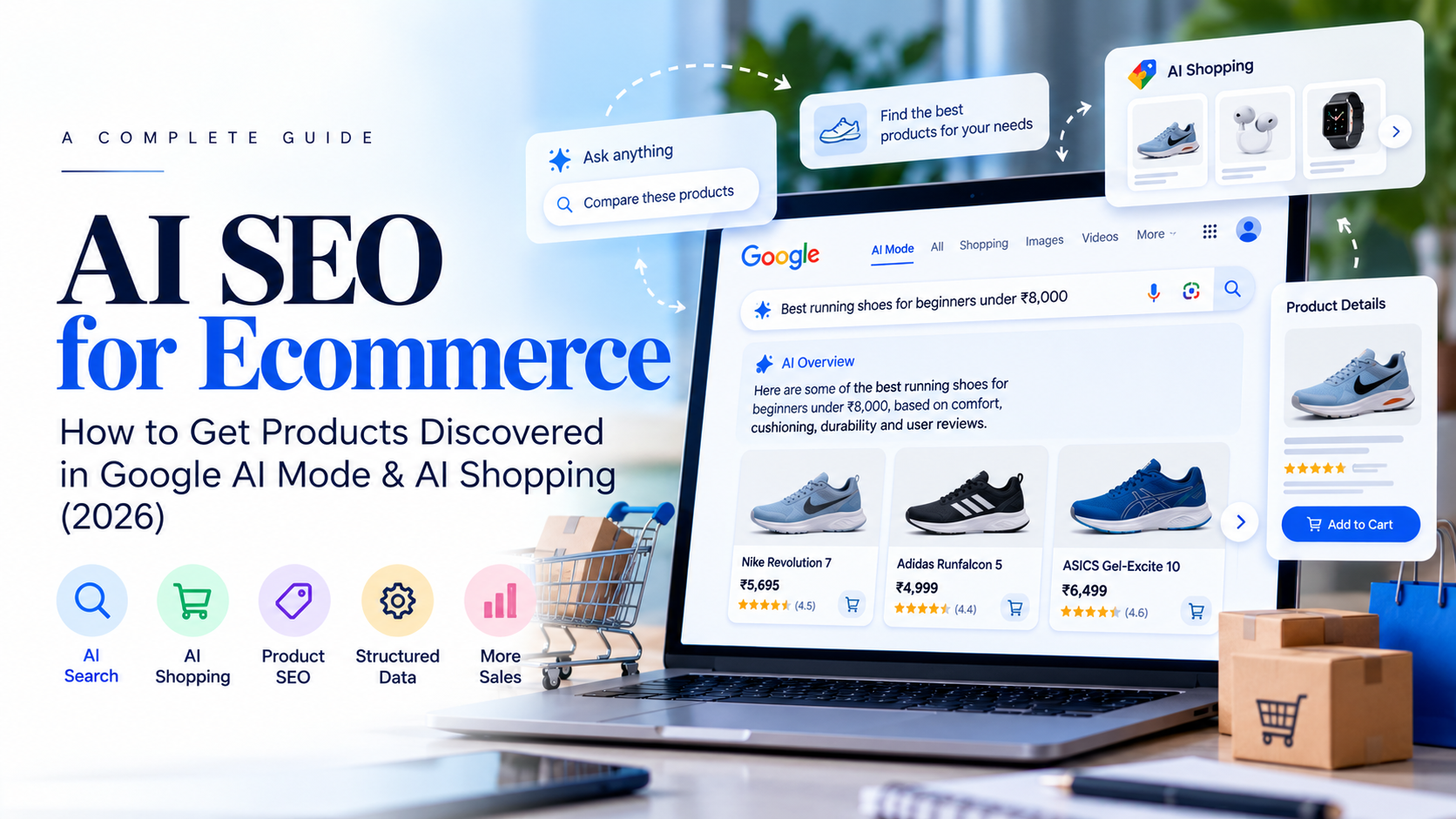
Ecommerce search is changing. Customers no longer rely only on short keyword searches to find products. They increasingly expect search experiences that understand their needs, compare alternatives and help them make informed buying decisions.
Instead of searching for “running shoes,” a customer might ask, “Which running shoes are best for beginners who run on roads and need extra cushioning under ₹8,000?”
AI-powered search can help shoppers explore these more detailed questions. Google’s AI Mode, AI-powered Shopping experiences and conversational product discovery are part of this broader shift.
For ecommerce businesses, this creates a new opportunity: AI SEO for Ecommerce.
The objective is to make your products easier to discover, understand and evaluate through strong product information, technical SEO, accurate inventory data, useful content and a reliable shopping experience.
In this guide, we explain how ecommerce brands can prepare their websites for AI-powered product discovery in 2026.
What Is AI SEO for Ecommerce?
AI SEO for Ecommerce is the practice of improving an online store’s product information, website structure, content and technical foundations to support discovery across traditional search engines and AI-powered shopping experiences.
It builds on established ecommerce SEO practices rather than replacing them.
These practices include:
- Optimizing product and category pages.
- Improving product titles and descriptions.
- Using accurate product structured data.
- Maintaining product feeds and inventory information.
- Improving website crawlability and internal linking.
- Publishing useful buying guides and comparisons.
- Making product images and videos informative.
- Monitoring organic search performance and AI visibility where measurable.
The important distinction is that AI SEO is not a magic formula for appearing in AI recommendations. No checklist guarantees that a product will be cited or recommended by a particular AI system.
Instead, the goal is to provide accurate, useful and accessible product information that supports both shoppers and search systems.
Why AI Search Matters for Ecommerce in 2026
Online shoppers often need more than a list of matching products. They want to understand which option fits their budget, requirements, preferences and circumstances.
AI-powered shopping experiences are designed to help users explore products through more conversational questions and comparisons.
Google announced the Universal Commerce Protocol (UCP) in January 2026 as an open standard designed to support agentic commerce across product discovery, purchasing and post-purchase interactions. Google subsequently announced further Shopping developments, including Universal Cart, in May 2026.
These developments illustrate how product discovery and purchasing experiences are evolving.
You can read Google’s official announcements here:
- Universal Commerce Protocol explained by Google Developers
- Google’s Universal Cart and shopping updates
Availability varies by platform, merchant eligibility and market. These developments do not mean every ecommerce website can immediately offer AI-powered checkout or will automatically appear in AI Shopping results.
For online retailers, the practical takeaway is to improve the product data, website quality and commerce infrastructure that support discovery and purchasing.
How AI SEO Differs From Traditional Ecommerce SEO
Traditional ecommerce SEO focuses on making category pages, product pages and other important URLs discoverable and relevant to search queries.
AI SEO builds on those foundations by considering how products and businesses can be understood in more conversational and context-rich discovery experiences.
| Traditional ecommerce SEO | AI SEO for ecommerce |
|---|---|
| Targets product and category keywords | Addresses detailed shopping questions and needs |
| Optimizes product titles and descriptions | Makes product attributes and use cases explicit |
| Focuses on crawlability and indexation | Retains these fundamentals while supporting richer product understanding |
| Uses product schema and structured content | Keeps product data accurate and consistent across supported sources |
| Tracks rankings, clicks and conversions | Also investigates AI visibility and referrals where measurable |
| Helps shoppers find product pages | Helps shoppers evaluate product suitability and alternatives |
These approaches overlap substantially. Strong traditional SEO remains an essential foundation for AI-powered product discovery.
10 Ways to Improve AI SEO for Ecommerce
1. Optimize Product Titles for Real Shopping Intent
A product title should identify the product clearly and include its most important distinguishing attributes.
Avoid vague titles such as:
“Premium Comfort Shoes”
A more informative title could be:
“Women’s Lightweight Running Shoes for Road Running – Blue”
The appropriate format depends on the product and the attributes shoppers use to compare options.
For ecommerce products, consider including relevant details such as:
- Brand and model.
- Product type.
- Intended use.
- Size or capacity.
- Material.
- Colour or variant.
- Compatibility or key specifications.
Do not stuff every possible keyword into the title. Keep it readable, accurate and consistent with the actual product.
2. Write Original, Helpful Product Descriptions
Product descriptions should answer the questions a potential customer is likely to ask before purchasing.
For example, a product description for a skincare product may need to explain its ingredients, intended use, directions, relevant precautions and suitability limitations.
A furniture product page might explain dimensions, material, finish, assembly requirements and maintenance.
An electronics product page might cover compatibility, ports, specifications and warranty information.
A useful product description should communicate:
- What the product is.
- Who it is designed for.
- What it does.
- Which features distinguish it.
- What limitations buyers should know.
- How to use or maintain it, where relevant.
Avoid copying supplier descriptions across hundreds of products without adding meaningful information.
3. Complete Your Product Data
Product attributes help shoppers compare alternatives.
Depending on the product category, include information such as:
- Price and currency.
- Availability.
- Size and colour variants.
- Dimensions and weight.
- Material and ingredients.
- Compatibility.
- Warranty and return information.
- Shipping details.
- Product identifiers, where applicable.
Use the correct values for each item and variant.
For example, if a product is available in three sizes, make sure the selected variant, displayed price, stock status and product data agree.
Incomplete or contradictory information creates friction for customers and can reduce the usefulness of your product listings.
4. Implement Accurate Product Structured Data
Product structured data helps Google understand supported product information and can make eligible pages suitable for certain search features.
Depending on the page and implementation, relevant properties may include:
- Product name.
- Image.
- Description.
- Brand.
- SKU or other appropriate identifiers.
- Offer price.
- Currency.
- Availability.
- Ratings and reviews, when genuine and eligible.
- Product variants, where supported.
Use Google’s official documentation as your implementation reference:
Google Search Central: Product structured data
Important: structured data does not guarantee a rich result, AI citation or higher ranking.
The markup should accurately reflect information visible on the page. Do not add fake reviews, misleading prices or unavailable offers.
After implementation, validate the markup with Google’s supported testing tools and monitor relevant Search Console reports.
5. Maintain Accurate Product Feeds
For stores using Google Merchant Center, product feed quality is an important part of managing product information across Google’s shopping surfaces.
Review the consistency between your feed and website.
Check:
- Product titles and descriptions.
- Prices and currency.
- Availability.
- Product images.
- Brand and identifiers.
- Variant information.
- Landing page URLs.
- Shipping and return information.
- Merchant Center diagnostics and policy issues.
A feed should reflect the actual products being sold, not outdated promotional information.
Google’s product information and Merchant Center guidance can help you understand the requirements for your specific market and product category.
Accurate data also supports a better customer experience by reducing the risk of shoppers finding incorrect prices or unavailable products.
6. Create Useful Buying Guides and Comparison Pages
Not every shopper begins with a product name. Many begin with a problem.
Examples include:
- Best office chairs for long working hours.
- How to choose a laptop for video editing.
- Which cookware material is right for everyday use?
- What should you consider before buying a water purifier?
- How to select skincare products for your routine.
These queries create opportunities for useful editorial content.
A good buying guide should explain the criteria that matter, compare relevant options fairly, identify trade-offs and help readers decide.
Where possible, support recommendations with real product specifications, genuine testing, expert input or other reliable evidence.
Disclose relevant commercial relationships and avoid presenting paid placements as objective rankings.
7. Improve Product Images and Videos
Visual information plays an important role in ecommerce discovery.
Use clear, high-quality images that accurately represent the product.
Useful practices include:
- Use original product photographs where practical.
- Show important angles and details.
- Include scale or dimensions where relevant.
- Add variant-specific images.
- Use descriptive filenames.
- Write useful alt text.
- Provide captions or transcripts for relevant product videos.
- Keep image URLs accessible and stable.
Alt text should describe the image meaningfully rather than repeat a list of keywords.
For example:
“Blue lightweight women’s road running shoe, side view”
is more useful than:
“Best shoes running shoes cheap shoes online.”
8. Build Strong Category Pages
Category pages are important discovery pages, especially when customers are comparing broad groups of products.
A useful category page should provide:
- A clear category heading.
- Relevant introductory information.
- Logical subcategories.
- Helpful filters and sorting.
- Descriptive product links.
- Useful buying advice where appropriate.
- Accessible pagination or product discovery controls.
Avoid creating hundreds of nearly identical category pages with little unique value.
If filters generate many URL variations, review your crawl and indexation strategy carefully so search engines can discover important products without wasting resources on unnecessary URL combinations.
9. Make Your Store Fast, Mobile-Friendly and Easy to Navigate
Product discovery is only useful if shoppers can comfortably use the website.
Review:
- Mobile usability.
- Page loading performance.
- Navigation and search.
- Product filters.
- Variant selection.
- Cart functionality.
- Checkout steps.
- Broken links and errors.
- Accessibility of interactive controls.
Make important product details available without forcing users through unnecessary popups or confusing interactions.
A clear shopping journey supports customer satisfaction and makes the store easier to understand and operate.
10. Build Trust Around Your Ecommerce Brand
Trust matters when customers are deciding whether to buy.
Provide accurate business information and make essential policies easy to find.
Depending on the business, this may include:
- Clear contact details.
- Shipping and delivery policies.
- Return and refund policies.
- Secure payment information.
- Authentic customer reviews.
- Warranty details.
- Accurate product claims.
- Transparent pricing and additional charges.
For specialist products, provide relevant expertise and appropriate supporting information.
Do not fabricate testimonials, ratings, certifications or product claims to influence AI systems or shoppers.
How to Optimize for Google AI Mode and AI Shopping
Google’s AI-powered shopping experiences are evolving, and eligibility and availability depend on the feature and market. Businesses should focus first on the product information and infrastructure they can control.
Keep Your Merchant Center Information Accurate
If you use Google Merchant Center, review product data quality, eligibility and account diagnostics regularly.
Resolve disapprovals and discrepancies rather than assuming that submitting a feed guarantees placement.
Align Your Website and Product Feed
Check that product names, prices, availability, variants and landing pages are consistent.
Update both systems when products change.
Provide Detailed Product Attributes
Shoppers may ask for products based on dimensions, material, budget, compatibility, intended use or other specific requirements.
Make relevant attributes explicit rather than leaving important details buried in vague marketing language.
Support Comparison and Decision-Making
Help customers understand differences between products through clear specifications, buying guides, comparison tables and honest explanations of trade-offs.
Follow Google’s Current Documentation
Features and requirements change. Check official Google Search Central and Merchant Center documentation before implementing new commerce integrations or assuming a feature is available in your market.
Google’s Universal Commerce Protocol is an emerging standard for agentic commerce, but it should not be confused with a mandatory SEO setting for every ecommerce store.
How to Measure AI SEO for Ecommerce
Do not evaluate your strategy solely by whether a product appears in one AI-generated response.
Track several types of performance.
1. Organic Search Performance
Use Google Search Console to monitor:
- Impressions.
- Clicks.
- Click-through rate.
- Search queries.
- Product and category landing pages.
Compare performance over meaningful periods and investigate changes by page type.
2. Ecommerce Conversions
Use your analytics and ecommerce platform to measure:
- Product views.
- Add-to-cart events.
- Checkout starts.
- Purchases.
- Revenue.
- Conversion rate.
- Product-level performance.
Check that your ecommerce tracking is correctly implemented before making decisions based on the numbers.
3. Product Feed Health
Monitor Merchant Center diagnostics, disapprovals, missing attributes, price discrepancies and availability issues.
These checks can reveal problems that prevent eligible products from being represented accurately.
4. AI Search Visibility
Where relevant and measurable, record whether your brand or product pages are mentioned or cited in AI-powered search experiences.
Use a consistent set of shopping questions and repeat checks over time.
AI answers can change by query, date, location and platform, so treat manual checks and third-party visibility tools as directional evidence rather than a definitive ranking report.
5. Revenue and Profitability
Ultimately, product discovery should support business goals.
Measure revenue and conversion performance alongside margins, returns and acquisition costs. More traffic is not automatically better if it does not lead to qualified purchases or profitable growth.
Common AI SEO Mistakes Ecommerce Businesses Should Avoid
Publishing Mass-Produced Product Descriptions
Large quantities of repetitive descriptions rarely help shoppers compare products. Improve the information quality rather than focusing only on page volume.
Adding Schema Without Fixing Product Data
Structured data cannot compensate for inaccurate prices, missing specifications or misleading content.
Ignoring Merchant Center Errors
A product feed with recurring disapprovals or inconsistent availability deserves attention before advanced optimization experiments.
Treating AI Visibility as Guaranteed
No agency or checklist can guarantee that a product will appear in every AI-generated recommendation.
Ignoring Traditional SEO
Crawlability, indexation, internal linking, useful content and technical quality remain foundational.
Overlooking Conversion Experience
Discovery is only one part of ecommerce performance. A slow, confusing or unreliable checkout can undermine the value of improved visibility.
Ecommerce AI SEO Checklist
Use this checklist when auditing your store.
Product pages
-
Descriptive and accurate product titles.
-
Original, useful descriptions.
-
Complete product attributes.
-
Clear prices and availability.
-
High-quality product images.
-
Accurate variant information.
Technical SEO
-
Important products and categories are crawlable.
-
Canonical URLs are correct.
-
Internal links work.
-
Product structured data is valid and accurate.
-
Mobile usability is reviewed.
-
Page performance is monitored.
Merchant Center
-
Product feed is current.
-
Prices and availability match the website.
-
Product identifiers are correct where applicable.
-
Image and landing page URLs work.
-
Diagnostics and disapprovals are reviewed.
Content and trust
-
Useful buying guides are available.
-
Comparisons are accurate and balanced.
-
Reviews are genuine.
-
Shipping and return policies are clear.
-
Product claims are supported.
Measurement
-
Search Console is monitored.
-
Ecommerce tracking is validated.
-
Product feed health is checked.
-
AI visibility checks are repeated consistently.
-
Conversions and revenue are measured.
Final Thoughts
AI SEO for Ecommerce is not about abandoning traditional search optimization or adding a special AI keyword to every product page.
It is about building a store that provides accurate product information, useful comparisons, accessible pages and a reliable buying experience.
As conversational search and agentic commerce develop, ecommerce businesses should make their product catalogues easier to understand and keep their website, feeds and business information consistent.
Start with the fundamentals: improve product descriptions, complete product attributes, validate structured data, maintain Merchant Center feeds and measure the customer journey.
These improvements create a stronger foundation for traditional search visibility and emerging AI-powered shopping experiences without relying on unrealistic ranking promises.
Frequently Asked Questions
What is AI SEO for Ecommerce?
AI SEO for Ecommerce is the process of improving an online store’s product pages, structured data, content, technical SEO and product feeds to support discovery through traditional and AI-powered search experiences.
How can ecommerce websites appear in Google AI Mode?
There is no guaranteed method. Focus on established SEO fundamentals, accurate product information, useful content, crawlable pages and eligible product data in supported Google services.
Is product schema important for AI Shopping?
Product structured data helps Google understand supported product information and can make eligible pages suitable for certain search features. It does not guarantee AI visibility or rankings.
Does Google Merchant Center help ecommerce SEO?
Merchant Center helps eligible merchants manage product information for Google’s shopping experiences. It complements website SEO but does not replace technical optimization or guarantee placement.
What is the Universal Commerce Protocol?
The Universal Commerce Protocol, or UCP, is an open standard announced by Google and industry partners to support agentic commerce interactions across discovery, purchasing and related commerce activities. Its availability and implementation depend on the participating platforms and merchants.
How do I measure AI SEO results for an online store?
Combine organic search metrics, product feed health, ecommerce conversions, revenue and repeated AI visibility checks where measurable. No single metric captures the full performance of AI SEO.
Does AI SEO replace traditional ecommerce SEO?
No. Traditional SEO remains foundational. AI SEO for ecommerce extends the same principles of technical accessibility, useful content, accurate product information and customer-focused optimization to evolving AI-powered discovery experiences.
STAY IN THE LOOP