
















Search is changing again.
For years, businesses optimized websites so people could find them through search engines.
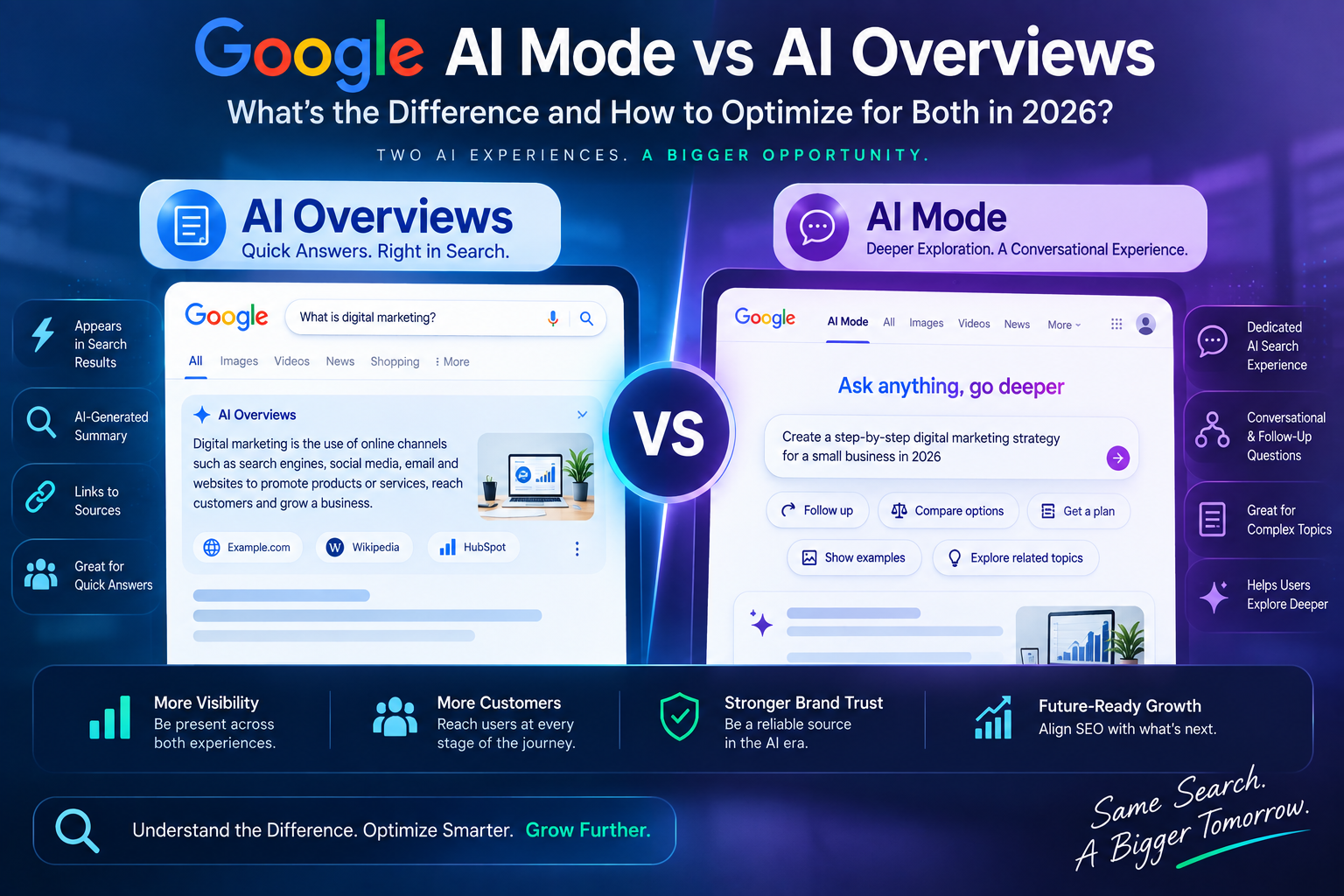
Then came AI Search, where people could ask longer questions and receive synthesized answers from systems such as Google AI Overviews, Google AI Mode and conversational AI platforms.
Now the next shift is already taking shape:
AI agents are starting to move from finding information to taking action.
Instead of simply asking:
“What are the best hotels in Jaipur?”
A user could eventually ask an AI agent to:
- Find hotels that match specific requirements
- Compare prices
- Check availability
- Shortlist the best options
- Complete a booking
Google has already introduced more agentic capabilities in Search, including information agents and agentic booking experiences. Google says AI Mode has surpassed 1 billion monthly users globally, while AI Overviews has more than 2.5 billion monthly active users.
This creates a new consideration for website owners:
Is your website easy for an AI agent to understand and interact with?
That is where Agent-Friendly SEO comes in.
What Is Agent-Friendly SEO?
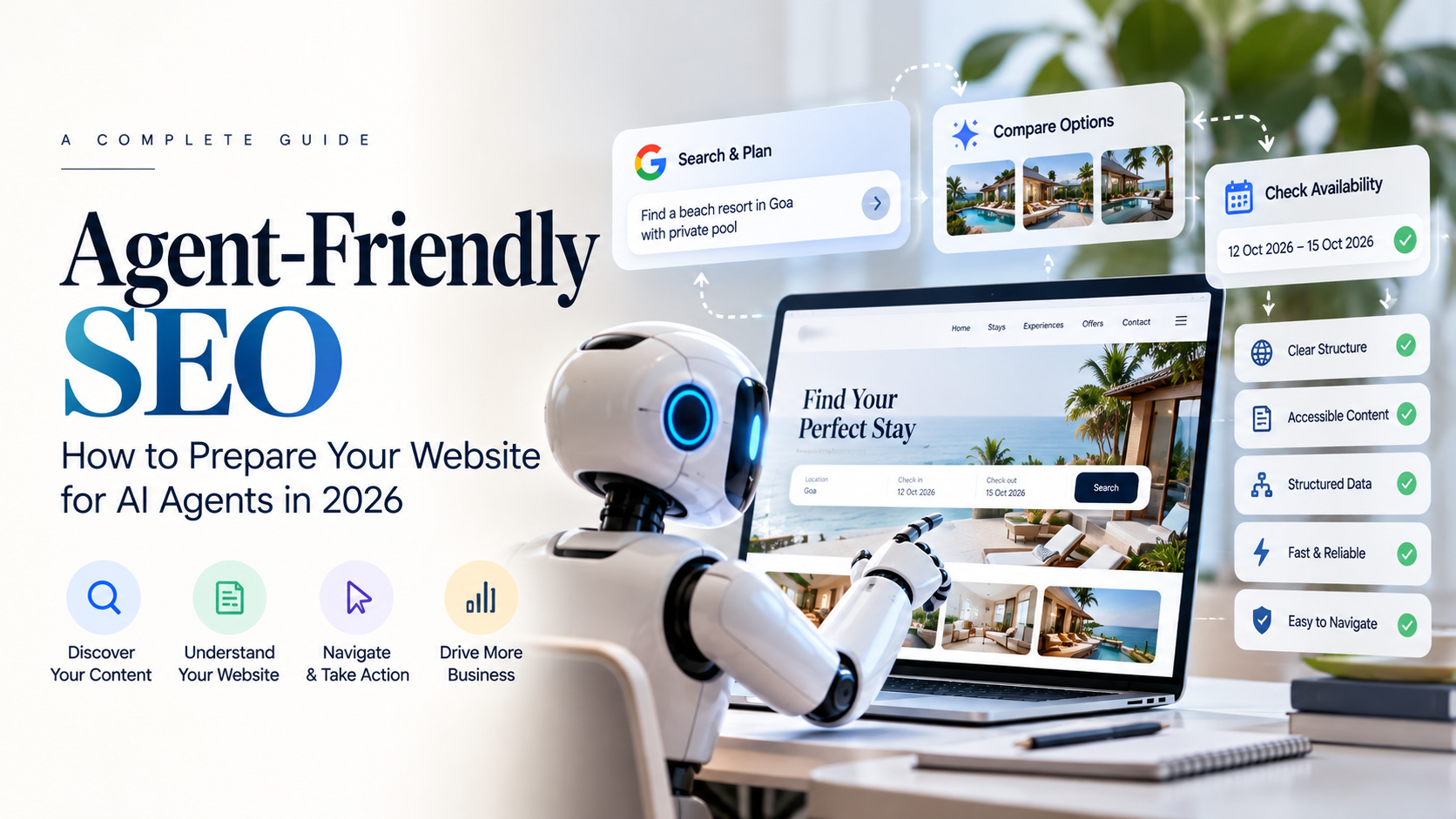
Agent-Friendly SEO is the practice of making a website easy for AI systems and browser agents to understand, navigate and interact with while completing tasks on behalf of users.
It combines several existing disciplines:
- Technical SEO
- Structured content
- Accessibility
- UX
- Clear navigation
- Structured data
- Fast page performance
- Reliable business information
- Machine-readable interfaces
- Strong conversion flows
It is important to understand that Agent-Friendly SEO is not a replacement for traditional SEO.
Google’s current guidance explicitly says traditional SEO fundamentals remain important for generative AI search. Clear technical structure, crawlability, valuable content and good page experience continue to matter.
The difference is that the website now needs to work well for another type of visitor: an AI agent acting on behalf of a person.
Why AI Agents Change Website Optimization
Traditional search largely follows this journey:
User → Search → Website → User takes action
Agentic search can introduce a different journey:
User → AI Agent → Websites → Agent evaluates options → User completes action
That changes what “good website optimization” means.
A human visitor can usually figure out:
“Click here to compare plans.”
An AI agent needs the page structure, labels, buttons and available information to be sufficiently clear for it to identify what the action actually does.
For example, a hotel website may have:
Check Availability
An agent needs to understand:
- What property is being booked
- Which dates are available
- Room types
- Occupancy
- Pricing
- Cancellation rules
- Booking conditions
- How to proceed
The more clearly the website communicates this information, the easier it becomes for both humans and machines to navigate.
Google’s current AI-search documentation notes that browser agents may interact with websites by analyzing visual renderings, DOM structure and accessibility trees.
AI Agents vs AI Search
These concepts are connected but different.
| AI Search | AI Agents |
|---|---|
| Finds and summarizes information | Can perform tasks |
| Answers questions | Takes actions |
| Provides links | Can navigate websites |
| Helps users research | Helps users complete objectives |
| Primarily discovery-focused | Action-focused |
For example:
AI Search
“What are the best CRM software options for a small business?”
The system may compare different products.
Agentic Search
“Find a CRM under ₹50,000 per year that supports five users and set up a demo with the best option.”
The second request requires much more than information retrieval.
The agent may need to:
- Find relevant companies
- Understand pricing
- Compare features
- Navigate the website
- Locate a demo form
- Fill in information
- Potentially complete the next step
That is why websites need to become increasingly clear, accessible and action-ready.
10 Ways to Make Your Website More Agent-Friendly
1. Keep Your Website Crawlable
The first requirement remains simple:
AI systems need access to your content.
Make sure important pages are:
- Crawlable
- Indexable
- Internally linked
- Accessible without unnecessary barriers
- Not accidentally blocked by robots.txt
- Not hidden behind inaccessible interactions
Google’s current guidance says crawlability remains fundamental to visibility in generative AI experiences.
Your homepage, service pages, product pages, pricing pages and important informational content should be easy to discover.
2. Use Clear Page Structure
A website should make sense even without relying heavily on visual styling.
Use:
- Descriptive headings
- Clear navigation
- Meaningful buttons
- Logical sections
- Readable text
- Semantic HTML where appropriate
For example:
Instead of:
Click Here
use:
View Digital Marketing Services
Instead of:
Learn More
use:
Explore SEO Services
Specific labels give both humans and automated systems more context.
Google also recommends semantic HTML where practical because it helps different users and technologies parse and navigate a page.
3. Make Important Information Visible
Don’t hide critical business information unnecessarily.
For example, an ecommerce product page should clearly communicate:
- Product name
- Price
- Availability
- Variants
- Size
- Material
- Delivery information
- Return policy
- Product specifications
A service business should clearly communicate:
- Service
- Location
- Pricing or pricing model
- Availability
- Service area
- Contact information
- Booking process
This helps customers make decisions and gives AI systems more reliable information to work with.
4. Make Buttons and Forms Understandable
Forms are particularly important in an agentic web.
Consider a form that says:
Submit
versus:
Request a Free SEO Consultation
The second button provides much more context.
The same principle applies to:
- Booking buttons
- Enquiry forms
- Checkout
- Appointment forms
- Product selection
- Quote requests
- Account creation
Keep labels descriptive and make the purpose of every action obvious.
5. Improve Accessibility
Accessibility and agent-friendliness increasingly overlap.
Use:
- Descriptive button labels
- Meaningful link text
- Form labels
- Appropriate heading hierarchy
- Keyboard-friendly navigation
- Useful alt text
- Sufficient contrast
- Accessible interactive elements
Why does this matter?
Google notes that browser agents may interpret a website’s accessibility tree while interacting with it.
So improving accessibility isn’t just about compliance or user experience.
It can also make the structure of your website easier for automated systems to interpret.
6. Don’t Hide Everything Behind JavaScript
Modern websites frequently rely on JavaScript.
That’s not automatically a problem.
But important information shouldn’t depend on complex interactions that make it difficult for systems to access or interpret the underlying content.
Google says Search can process JavaScript, but JavaScript-based websites can introduce additional SEO complexity.
For important content, ensure that:
- Text is available in the DOM
- Navigation works correctly
- Links are real links
- Important information isn’t only rendered visually
- Essential actions don’t depend on fragile interactions
Think:
Progressive enhancement rather than unnecessary complexity.
7. Build Strong Product and Service Pages
Agentic search will be particularly important for businesses where users need to compare options.
Examples include:
Ecommerce
Make product information easy to understand:
- Price
- Stock
- Size
- Colour
- Specifications
- Shipping
- Returns
Hospitality
Provide:
- Room types
- Amenities
- Prices
- Availability
- Policies
- Location
Healthcare
Clearly communicate:
- Treatment
- Doctor/service provider
- Location
- Consultation options
- Appointment process
Real Estate
Provide:
- Property type
- Location
- Price
- Area
- Amenities
- Availability
- Contact/visit options
The more complete the information, the easier it becomes to evaluate an option.
8. Keep Business Information Consistent
AI systems increasingly work across multiple sources.
Your website should therefore agree with your:
- Google Business Profile
- Merchant Center information
- Social profiles
- Directories
- Product feeds
- Booking platforms
- Other authoritative business listings
For local and ecommerce businesses, Google specifically recommends maintaining accurate business and product information because these can surface across both traditional and AI-powered Search experiences.
If your website says:
₹1,999
but another important source says:
₹2,499
you create unnecessary ambiguity.
Consistency builds trust.
9. Use Structured Data — But Don’t Treat It as an AI Hack
Structured data remains useful.
Depending on your website, you may use appropriate schema for:
- Organization
- LocalBusiness
- Product
- Article
- Breadcrumb
- Event
- Service
But don’t fall into the trap of thinking:
“Add special AI schema and Google will recommend my business.”
Google’s current documentation explicitly says there is no special schema markup required for generative AI search. Structured data remains useful as part of an overall SEO strategy, particularly for helping Google understand pages and qualifying for supported search features.
The goal is accurate machine-readable information — not an AI ranking shortcut.
10. Make the User Journey Simple
This may become one of the biggest differentiators.
Imagine two websites.
Website A
Homepage → Services → Pricing → Contact → Form → Confirmation
Website B
Homepage → Multiple popups → unclear buttons → JavaScript menu → hidden pricing → complicated form → third-party redirect
A human may eventually figure out Website B.
An automated agent has a much harder job.
Agent-friendly websites should make important journeys predictable and straightforward.
For example:
Product → Select Variant → Add to Cart → Checkout
or:
Service → Select Location → Choose Date → Book Appointment
or:
Property → View Details → Check Availability → Enquire
The simpler the journey, the easier it is to automate.
What About llms.txt?
This is an important one because it is frequently discussed in AI SEO.
You may have heard that websites should create an llms.txt file to become visible in AI search.
Google’s current guidance says this is not required for Google Search, including its generative AI features, and Google says such files do not positively or negatively affect Search visibility or rankings.
So don’t spend your SEO budget chasing an “AI file” while ignoring:
- technical SEO
- crawlability
- useful content
- accessibility
- structured information
- page experience
- business data
- conversion paths
Those fundamentals are much more important.
Does Agent-Friendly SEO Replace SEO?
No.
It extends it.
Think about the evolution:
SEO
Help search engines discover and understand your website.
↓
AI Search Optimization
Help your content remain useful and discoverable in AI-powered search experiences.
↓
Agent-Friendly SEO
Make your website understandable and usable when AI systems interact with it on behalf of users.
These aren’t three completely separate disciplines.
They are increasingly overlapping parts of the same web ecosystem.
Google’s own guidance makes the same broader point: foundational SEO remains the foundation for generative AI Search.
Agent-Friendly SEO Checklist
Before calling your website agent-ready, review these areas.
Technical
☐ Website is crawlable
☐ Important pages are indexable
☐ Internal links work
☐ Mobile experience works properly
☐ Pages load efficiently
☐ JavaScript doesn’t hide essential information
☐ Important content exists in the DOM
Content
☐ Service information is clear
☐ Product information is complete
☐ Pricing is understandable
☐ Business information is accurate
☐ Content provides genuine value
☐ Important information isn’t unnecessarily hidden
UX
☐ Navigation is logical
☐ Buttons have descriptive labels
☐ Forms have clear labels
☐ Important actions are easy to find
☐ Checkout/booking journeys are simple
☐ Users can easily understand what happens next
Accessibility
☐ Images have useful alt text
☐ Forms are labelled
☐ Links are descriptive
☐ Interactive elements are keyboard accessible
☐ Heading hierarchy is logical
☐ Accessibility isn’t treated as an afterthought
SEO
☐ Titles are descriptive
☐ Meta descriptions are useful
☐ Structured data is accurate
☐ Canonicals are correct
☐ XML sitemap is maintained
☐ Search Console is monitored
☐ Content is internally linked
How to Measure Agent-Friendly SEO
This area is still developing.
You shouldn’t expect a single “Agent Score” inside Google Search Console.
Instead, monitor several signals.
1. AI Search Visibility
Track whether your pages appear in generative AI search experiences.
Google has introduced reporting for generative AI features in Search Console, including information about impressions and which pages appear in AI responses.
2. Organic Search Performance
Continue tracking:
- impressions
- clicks
- CTR
- rankings
- conversions
Agentic experiences don’t make traditional SEO metrics irrelevant.
3. AI Mentions and Citations
Monitor whether your brand and important pages appear when users ask relevant questions across major AI platforms.
4. Conversion Paths
Watch whether visitors arriving through AI-powered discovery:
- submit forms
- call
- book
- purchase
- request a quote
5. Website Usability
Monitor:
- form completion
- checkout abandonment
- page speed
- broken journeys
- mobile usability
Agent-friendly optimization should ultimately support business outcomes, not simply visibility.
The Future: Websites May Become Interfaces for AI Agents
The biggest change isn’t simply that AI will read websites.
It is that AI may increasingly interact with them.
Google has already introduced agentic capabilities in Search, including agents that can monitor information and experiences designed to help users complete tasks. Google has also highlighted emerging protocols such as the Universal Commerce Protocol (UCP) as part of the evolving agentic ecosystem.
That could eventually change how people discover and interact with businesses.
Instead of:
Search → Click → Read → Compare → Decide → Act
the experience could become:
Ask → AI researches → AI compares → AI recommends → User approves → Action
Websites will still matter.
But the interface between the user and the website may increasingly include an AI agent.
Final Takeaway
Agent-Friendly SEO isn’t about optimizing a website for robots instead of people.
It is about making your website:
- easier to understand
- easier to navigate
- easier to access
- easier to trust
- easier to interact with
And those improvements are usually good for human visitors too.
The smartest approach in 2026 isn’t to abandon traditional SEO for another new acronym.
It is to build a website with strong technical foundations, useful original content, clear information architecture, accessible interfaces and simple conversion journeys.
As AI Search evolves from answering questions to helping people take action, websites that are structured for both humans and machines will be better positioned for what comes next.
FAQs
What is Agent-Friendly SEO?
Agent-Friendly SEO is the process of making a website easier for AI agents and browser agents to understand, navigate and interact with while completing tasks for users.
Is Agent-Friendly SEO different from AI SEO?
They overlap but have different emphasis. AI SEO focuses largely on visibility in AI-powered search and generative results, while Agent-Friendly SEO also considers how AI agents interact with the website itself.
Does Google require special SEO for AI agents?
No. Google continues to emphasize foundational SEO, crawlability, useful content, technical clarity and good page experience. Its current guidance also recommends exploring agentic experiences as the technology develops.
Does llms.txt help with Google AI Search?
Google says llms.txt is not required for Google Search and does not positively or negatively affect visibility or rankings.
Why is accessibility important for AI agents?
Browser agents may use information from a website’s visual rendering, DOM structure and accessibility tree to understand and interact with pages.
Will AI agents replace websites?
Not necessarily. AI agents may change how users interact with websites, but websites remain important sources of information, products, services and actions. The more likely shift is toward websites becoming easier for both people and software agents to navigate.
STAY IN THE LOOP