
















Introduction
AI is changing how people discover information online.
Users can now ask detailed questions and receive synthesized answers through Google’s AI search experiences and conversational platforms such as ChatGPT and Gemini.
But optimizing for AI search isn’t about finding one secret ranking factor.
It starts with the fundamentals.
Google’s current guidance says that the same foundational SEO practices remain important for its generative AI search experiences. It also emphasizes creating unique, valuable content rather than producing large amounts of low-value content simply to manipulate search visibility.
So before investing heavily in AI SEO, GEO, or AEO, businesses should first make sure their website is technically healthy, useful, authoritative, and easy to understand.
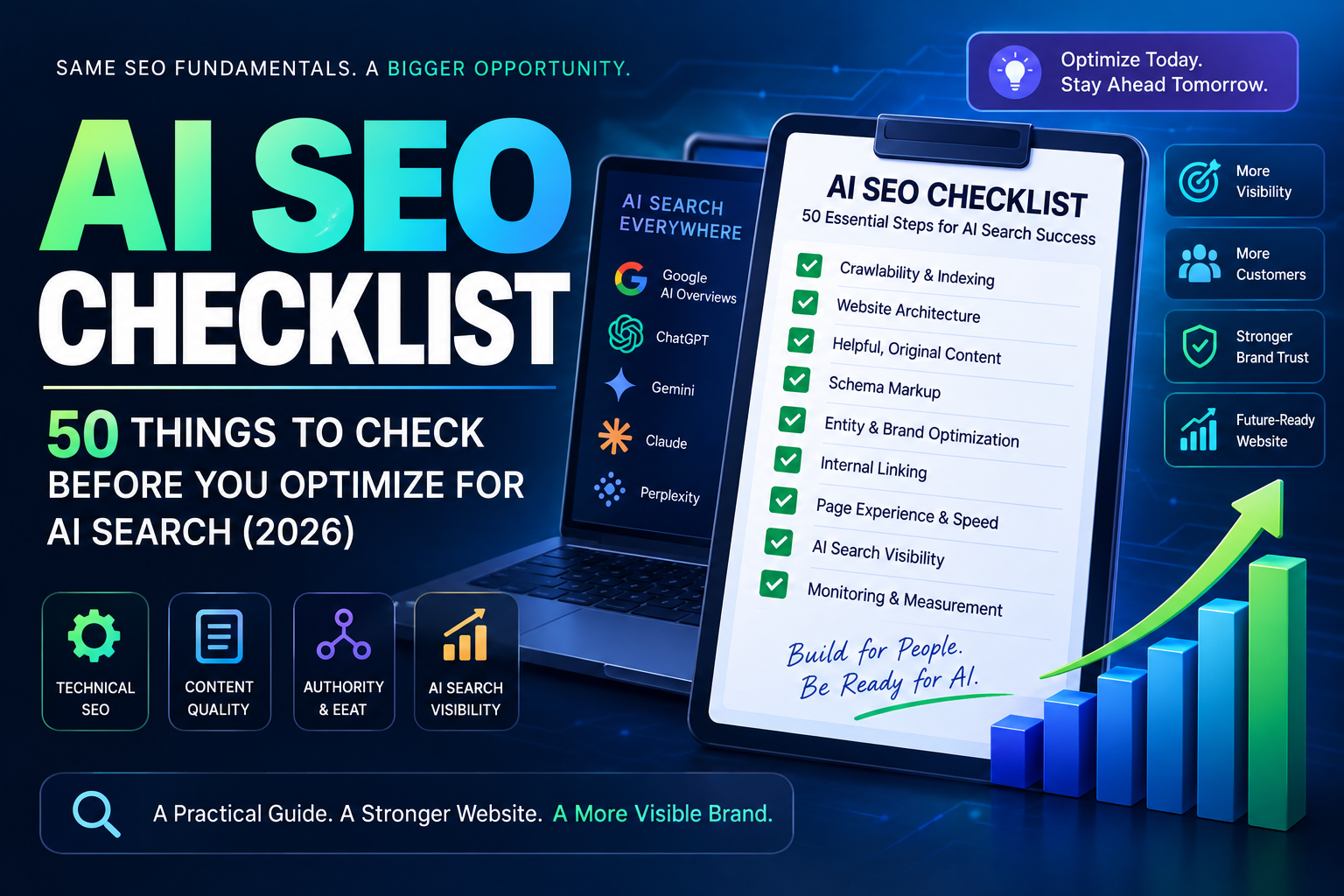
That’s exactly what this 50-point AI SEO checklist is designed to help you do.
What Is an AI SEO Checklist?
An AI SEO checklist is a structured set of technical, content, authority, and website optimization checks designed to prepare a business for modern search experiences.
It covers areas such as:
- Technical SEO
- AI search visibility
- Content quality
- Entity optimization
- Structured data
- Internal linking
- EEAT
- Brand authority
- Website performance
- AI-search measurement
Think of it as a health check for your website before you start trying to improve its visibility in AI-powered search.
Part 1: Technical SEO Checklist
Before worrying about AI search, make sure search engines can actually access your website.
1. Check Website Crawlability
Make sure important pages can be discovered and crawled.
2. Check Your Robots.txt
Make sure important sections of the website aren’t accidentally blocked.
3. Check Your XML Sitemap
Your sitemap should contain the URLs you actually want search engines to discover.
4. Check Indexing
Use Google Search Console to identify important pages that aren’t indexed.
5. Fix Broken Links
Find and fix broken internal and external links that create poor user experiences.
6. Check Canonical URLs
Make sure canonical tags point to the correct preferred URLs.
7. Fix Redirect Problems
Avoid unnecessary redirect chains and incorrect redirects.
8. Check HTTPS
Your website should use a secure HTTPS connection.
9. Optimize Mobile Experience
Your website should work properly across mobile devices.
10. Monitor Core Web Vitals
Check loading performance, responsiveness, and visual stability.
Part 2: Website Architecture Checklist
Your website should have a structure that makes sense to both users and search systems.
11. Create Clear Navigation
Users should be able to reach important pages easily.
12. Organize Services Properly
Group related services into logical categories.
For example:
Digital Marketing
→ SEO
→ AI SEO
→ Google Ads
→ Social Media
→ Content Marketing
13. Create Relevant Topic Clusters
Don’t publish disconnected blogs.
Build groups of related content around important topics.
14. Use Descriptive URLs
Keep URLs short and meaningful.
For example:
/ai-seo-guide/
is clearer than:
/blog/article123/
15. Add Breadcrumbs
Breadcrumbs can help communicate page hierarchy.
Part 3: Content Checklist
Content remains one of the most important parts of an AI-search strategy.
Google’s guidance for generative AI search emphasizes unique, non-commodity content and continuing to follow established SEO fundamentals.
16. Answer Real Questions
Create content around questions your customers actually ask.
17. Provide the Answer Clearly
Don’t hide the main answer under five paragraphs of introduction.
Give readers useful information early.
18. Create Original Content
Add:
- Experience
- Examples
- Data
- Opinions
- Case studies
- Original research
19. Avoid Thin Content
Don’t create hundreds of short pages that provide little value.
20. Avoid Keyword Stuffing
Write naturally around the topic and user intent.
21. Use Clear H1s
Every important page should have a clear primary topic.
22. Use Descriptive H2s and H3s
Organize information logically.
23. Include Relevant Examples
Examples make abstract concepts easier to understand.
24. Use Tables Where Useful
Comparison tables can make complex information easier to process.
25. Update Important Content
Refresh outdated:
- Statistics
- Examples
- Screenshots
- Product information
- Recommendations
Part 4: AI Search Content Checklist
Now move beyond basic SEO.
26. Create Question-Based Content
Target questions such as:
What is AI SEO?
How does GEO work?
How can my business appear in ChatGPT?
27. Build Topic Clusters
For Digital Corn, your AI-search cluster can include:
AI Visibility
→ GEO
→ ChatGPT
→ Google AI Overviews
→ AI SEO
→ AEO
→ Schema
→ AI-Ready Websites
28. Connect Related Articles
Use contextual internal links between related articles.
29. Cover Different Search Intents
Create content for:
- Informational intent
- Commercial intent
- Transactional intent
- Navigational intent
30. Include FAQs
Answer genuine questions rather than creating FAQs just to add keywords.
Part 5: Entity & Brand Checklist
AI search isn’t only about individual webpages.
Your brand itself needs to be understandable.
31. Clearly Define Your Business
Your website should clearly explain:
Who you are
What you do
Who you serve
Where you operate
32. Maintain Consistent Business Information
Keep your business name, website, contact information and other important details consistent across relevant platforms.
33. Create an Organization Entity
Use appropriate Organization structured data where applicable.
34. Create Clear About Information
Your About page should explain the company’s expertise and background.
35. Create Author Profiles
Identify who creates important content.
Part 6: Schema & Structured Data Checklist
Structured data can help search engines understand content, but it isn’t a guaranteed shortcut into AI results.
Google explicitly says there is no special schema required for AI Overviews or AI Mode. Structured data should accurately represent visible content.
36. Implement Organization Schema
Where appropriate, describe your organization accurately.
37. Implement Article Schema
Use appropriate structured data for articles.
38. Use Breadcrumb Schema
Where applicable, communicate the site’s hierarchy.
39. Use Service Schema Where Appropriate
Make sure service information is genuinely represented on the page.
40. Validate Your Structured Data
Check for errors and make sure your markup matches the visible content.
Part 7: EEAT & Authority Checklist
AI visibility isn’t just about technical optimization.
Your business needs credibility.
41. Show Real Expertise
Demonstrate actual experience rather than simply claiming expertise.
42. Add Case Studies
Show what you have actually done.
43. Add Genuine Testimonials
Use real customer experiences.
44. Build Relevant Brand Mentions
Earn genuine mentions through:
- Digital PR
- Industry publications
- Interviews
- Podcasts
- Partnerships
- Relevant directories
45. Earn Quality Backlinks
Prioritize relevance and authority over large numbers of low-quality links.
Part 8: AI Visibility Measurement Checklist
AI search results can vary from one query or run to another, so don’t judge visibility from a single test.
Recent research on GEO measurement specifically highlights the probabilistic nature of AI search and recommends repeated measurements rather than treating one result as definitive.
46. Track Your Organic Search Performance
Monitor:
- Impressions
- Clicks
- CTR
- Rankings
- Indexed pages
47. Track AI Mentions
Test important queries across relevant AI search platforms and record whether your brand appears.
48. Track Citations
Record which of your webpages are being cited or referenced when your brand appears.
49. Track Brand Searches
Look for changes in branded search demand over time.
50. Review Your Strategy Regularly
AI search is changing quickly.
Don’t optimize once and forget about it.
Review your strategy periodically.
The 50-Point AI SEO Checklist
Here’s the quick version you can save:
Technical SEO
☐ Crawlability
☐ Robots.txt
☐ XML Sitemap
☐ Indexing
☐ Broken Links
☐ Canonicals
☐ Redirects
☐ HTTPS
☐ Mobile Experience
☐ Core Web Vitals
Website Structure
☐ Navigation
☐ Service Architecture
☐ Topic Clusters
☐ Clean URLs
☐ Breadcrumbs
Content
☐ Customer Questions
☐ Direct Answers
☐ Original Content
☐ No Thin Content
☐ No Keyword Stuffing
☐ Clear H1
☐ Clear H2/H3
☐ Examples
☐ Tables
☐ Content Updates
AI Search
☐ Question-Based Content
☐ Topic Clusters
☐ Internal Links
☐ Search Intent
☐ FAQs
Entity & Brand
☐ Business Identity
☐ Consistent Information
☐ Organization Entity
☐ About Page
☐ Author Profiles
Structured Data
☐ Organization Schema
☐ Article Schema
☐ Breadcrumb Schema
☐ Service Schema
☐ Schema Validation
Authority
☐ Expertise
☐ Case Studies
☐ Testimonials
☐ Brand Mentions
☐ Quality Backlinks
Measurement
☐ Organic Performance
☐ AI Mentions
☐ AI Citations
☐ Branded Search
☐ Regular Audits
What You Should NOT Do for AI SEO
There are also several things businesses should avoid.
Don’t Generate Hundreds of Low-Value AI Articles
Google’s spam policies specifically identify scaled content abuse as a problem when large quantities of content are created primarily to manipulate search rankings rather than help users. This applies regardless of whether AI or another method was used to create it.
Don’t Stuff Keywords
Repeating “AI SEO” dozens of times doesn’t make an article authoritative.
Don’t Create Fake Reviews
Don’t manufacture testimonials, ratings, or customer experiences.
Don’t Add Fake Schema
Structured data should accurately represent what users can see.
Don’t Promise Guaranteed AI Rankings
No legitimate agency can guarantee that ChatGPT, Gemini, Google AI Overviews, or another AI platform will recommend a particular business.
How Digital Corn Can Help
An AI SEO audit shouldn’t stop at keywords.
At Digital Corn, an AI-search strategy can combine:
- Technical SEO
- AI SEO
- AI Visibility
- GEO
- AEO
- Schema
- Content Strategy
- Topic Clusters
- Entity Optimization
- EEAT
- Digital PR
- Website Optimization
The objective is to build a website that is technically strong, useful to people, understandable to search systems, and credible enough to earn visibility.
Frequently Asked Questions
What is an AI SEO checklist?
An AI SEO checklist is a practical framework for reviewing the technical, content, authority, structured-data, and measurement elements that influence a website’s readiness for modern AI-powered search.
Is AI SEO different from traditional SEO?
AI SEO expands traditional SEO for modern search experiences. Technical SEO, crawlability, helpful content, links, and user experience remain foundational.
Does schema guarantee AI visibility?
No. Schema can help search engines understand content, but it does not guarantee inclusion in AI Overviews or AI-generated answers. Google’s current guidance confirms there is no special schema required for AI Overviews or AI Mode.
How often should I perform an AI SEO audit?
For important websites, review technical health regularly and conduct a broader AI-search/content audit periodically. The exact frequency depends on how quickly your industry and website change.
Can AI-generated content be used for SEO?
AI can be used as a tool for research, brainstorming, editing, and content production. But content should provide genuine value and not be mass-produced primarily to manipulate rankings. Google’s spam policies apply to generative AI content as well.
Can small businesses benefit from AI SEO?
Yes. Small businesses can start with the fundamentals: clear service pages, useful content, accurate business information, technical SEO, strong reviews, relevant structured data, and consistent brand building.
Conclusion
AI SEO isn’t about finding a shortcut into ChatGPT or Google AI.
It’s about building a website that deserves to be discovered.
Start with the fundamentals.
Make your website crawlable.
Create genuinely useful content.
Answer customer questions.
Build topical authority.
Use structured data accurately.
Strengthen your brand and expertise.
Then measure what happens across both traditional and AI-powered search.
The businesses that approach AI SEO as a long-term digital strategy, rather than a collection of quick tricks, will be better positioned as search continues to evolve.
Use this 50-point checklist as your starting point—and keep improving.
STAY IN THE LOOP