










For months, advertising on ChatGPT felt like an exclusive club.
Only a handful of enterprise brands and agency partners had access, while the rest of the industry watched from the sidelines. That era is officially over.
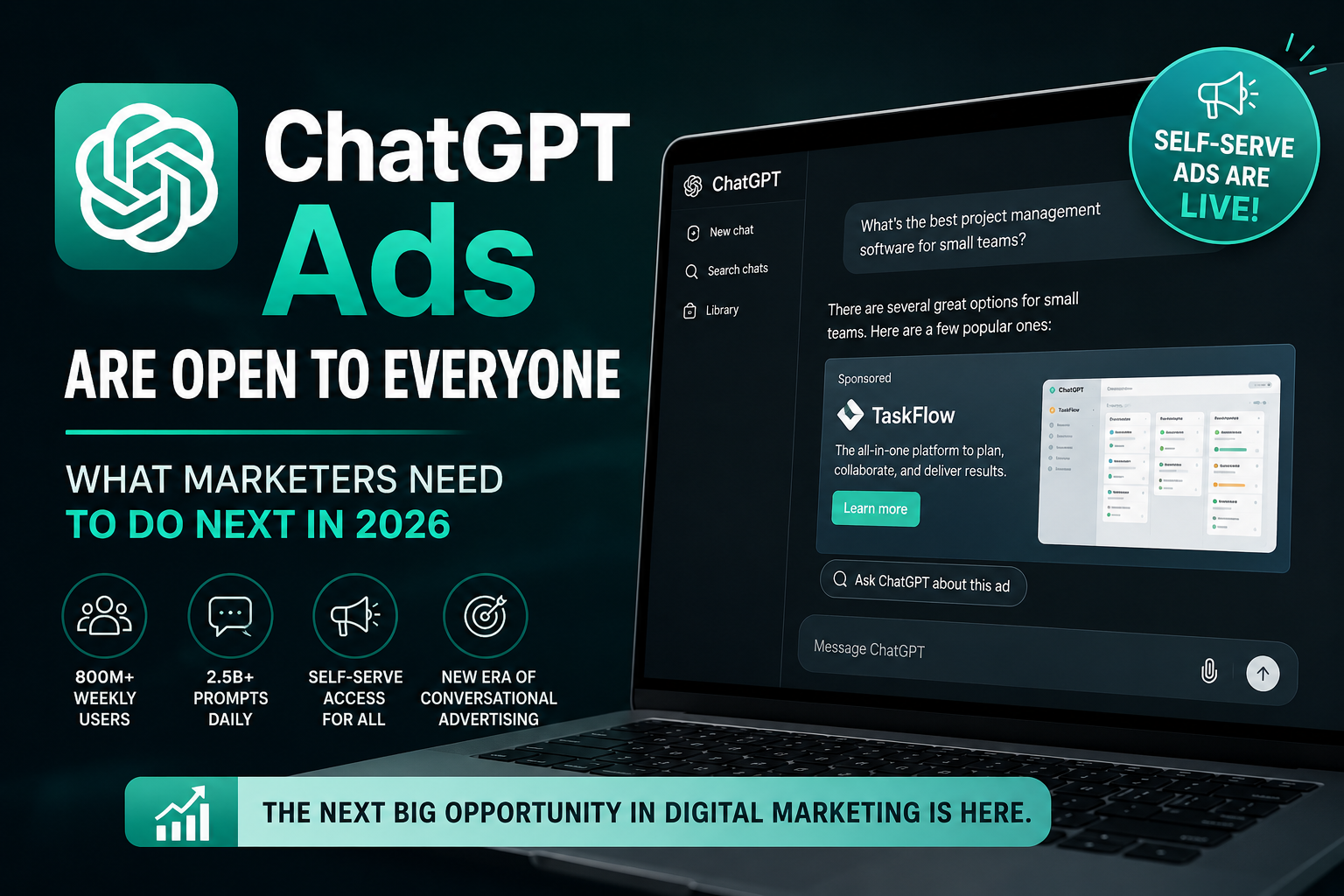
OpenAI has now removed the barriers to entry and launched its self-serve Ads Manager, allowing businesses of all sizes to advertise on ChatGPT. What was once an invitation-only experiment is quickly becoming a new performance channel.
The question is no longer “Should we pay attention?”
It’s “How quickly can we learn before everyone else catches up?”
The Numbers That Matter
ChatGPT’s advertising business has had an explosive start.
In just six weeks, the platform generated more than $100 million in annualized ad revenue. What’s even more interesting is that this figure came while less than 20% of eligible users were seeing ads on a daily basis.
At the same time:
- Approximately 85% of Free and Go users are eligible to receive ads
- ChatGPT now reaches 800 million weekly active users
- Users generate roughly 2.5 billion prompts every day
- The previous $50,000 minimum spend requirement has been eliminated
- Businesses can now launch campaigns directly through OpenAI’s self-serve platform
In other words, ChatGPT advertising hasn’t reached full capacity yet. The inventory is still relatively underutilized, and that’s exactly where early opportunities tend to emerge.
Why ChatGPT Isn’t Just Another Ad Platform
Many advertisers will make the same mistake they made during the early days of social media: copying existing campaigns and expecting similar results.
That won’t work here.
ChatGPT isn’t built around feeds, scrolling behavior, or keyword matching. It’s built around conversations.
Think about how users interact with the platform.
Someone searching on Google may still be exploring options. A social media user might not even have purchase intent.
A ChatGPT user, however, often spends several interactions refining their problem:
- “Which CRM is best for small businesses?”
- “Compare HubSpot and Zoho for my use case.”
- “What’s the pricing difference?”
- “Which one integrates with Shopify?”
By the time an ad appears, the AI has already guided the discovery process.
The user isn’t just browsing.
They’re much closer to making a decision.
That shift fundamentally changes how marketers should approach messaging, offers, and landing pages.
A Different Type of Intent
Traditional advertising relies heavily on:
- Keywords
- Demographics
- Interests
- Behavioral audiences
ChatGPT introduces a different signal.
Ads are matched using:
- The context of the current conversation
- Previous interactions with ChatGPT
- Historical engagement with ads
- Ongoing user intent expressed through dialogue
This creates a richer picture of intent than a single keyword ever could.
Instead of targeting someone who searched “project management software,” you’re reaching someone who has spent ten minutes discussing team size, integrations, pricing concerns, and implementation challenges.
That’s a very different buyer.
The Two ChatGPT Ad Formats Available Today
While the ecosystem is still young, two ad formats have already emerged.
1. Shopping Product Carousels
Designed primarily for eCommerce brands, these ads showcase products directly beneath ChatGPT responses.
They’re ideal for:
- Consumer products
- Visually appealing items
- Straightforward buying journeys
- Quick purchase decisions
The user can move seamlessly from discovery to checkout.
2. Conversational Ads
This format may become the real differentiator.
Alongside the call-to-action, users can click an “Ask ChatGPT About This Ad” button.
Instead of being redirected immediately, they can ask questions such as:
- What’s included in the subscription?
- Do you offer annual pricing?
- Will this work for my business size?
- How long does implementation take?
ChatGPT answers using information provided by the advertiser, including FAQs, product specifications, and service details.
For B2B companies and high-consideration purchases, this effectively turns the ad into an interactive sales assistant.
Where the Biggest Opportunities Exist
Not every industry will benefit equally from ChatGPT advertising—at least not initially.
The strongest early use cases include:
B2B Software
Software evaluations naturally involve comparison, education, and multiple questions, making conversational ads highly effective.
Professional Services
Consultancies, agencies, and service providers can address objections before prospects ever reach a sales call.
Financial Products
Complex decisions require trust and detailed explanations—exactly the type of interactions ChatGPT supports.
Travel and Hospitality
Users increasingly ask AI for recommendations, itineraries, and destination comparisons before booking.
Health and Wellness
Educational conversations often precede purchases in this category, creating strong intent signals.
High-Consideration Consumer Products
Consumers researching specifications, features, and alternatives are ideal candidates for conversational advertising experiences.
Low-cost impulse purchases may see weaker performance until additional formats evolve.
How Marketers Should Approach Testing
The biggest mistake would be waiting for the channel to mature before experimenting.
Instead:
Identify the Questions Customers Ask
Use ChatGPT itself to understand how users discuss your category.
What comparisons emerge?
What objections surface repeatedly?
What language does the AI naturally use?
These moments represent the conversational equivalent of high-intent keywords.
Adapt Your Creative
Traffic from ChatGPT behaves differently.
Your landing pages should assume that visitors already understand:
- The problem
- Available solutions
- Basic product education
Focus on differentiation, proof points, and conversion.
Start Small
Approach initial campaigns as learning investments rather than immediate revenue drivers.
The objective isn’t maximizing ROAS from day one.
It’s building institutional knowledge before competition intensifies.
The Bigger Shift in Digital Discovery
This isn’t just another advertising update.
It’s a signal that discovery itself is evolving.
Google transformed intent-driven advertising through search.
Facebook reshaped audience targeting through social data.
ChatGPT introduces something new: conversation-driven intent.
With hundreds of millions of weekly users already relying on AI to research products, compare options, and solve problems, brands can no longer treat conversational platforms as experiments.
History suggests that early adopters often gain advantages that compound over time.
The brands that learned Google Ads in the early 2000s benefited from lower costs and less competition.
The same was true for Facebook advertisers a decade later.
ChatGPT may be entering that same phase now.
Final Thoughts
Generating over $100 million in annualized revenue within six weeks, while operating at only a fraction of its potential inventory, is a strong indication that ChatGPT advertising is more than a passing trend.
The self-serve model has lowered the barrier to entry.
Competition will inevitably increase.
Costs will rise.
The current advantage belongs to marketers willing to experiment, gather data, and understand how conversational intent differs from traditional channels.
The window is open.
It won’t stay open forever.
STAY IN THE LOOP