




















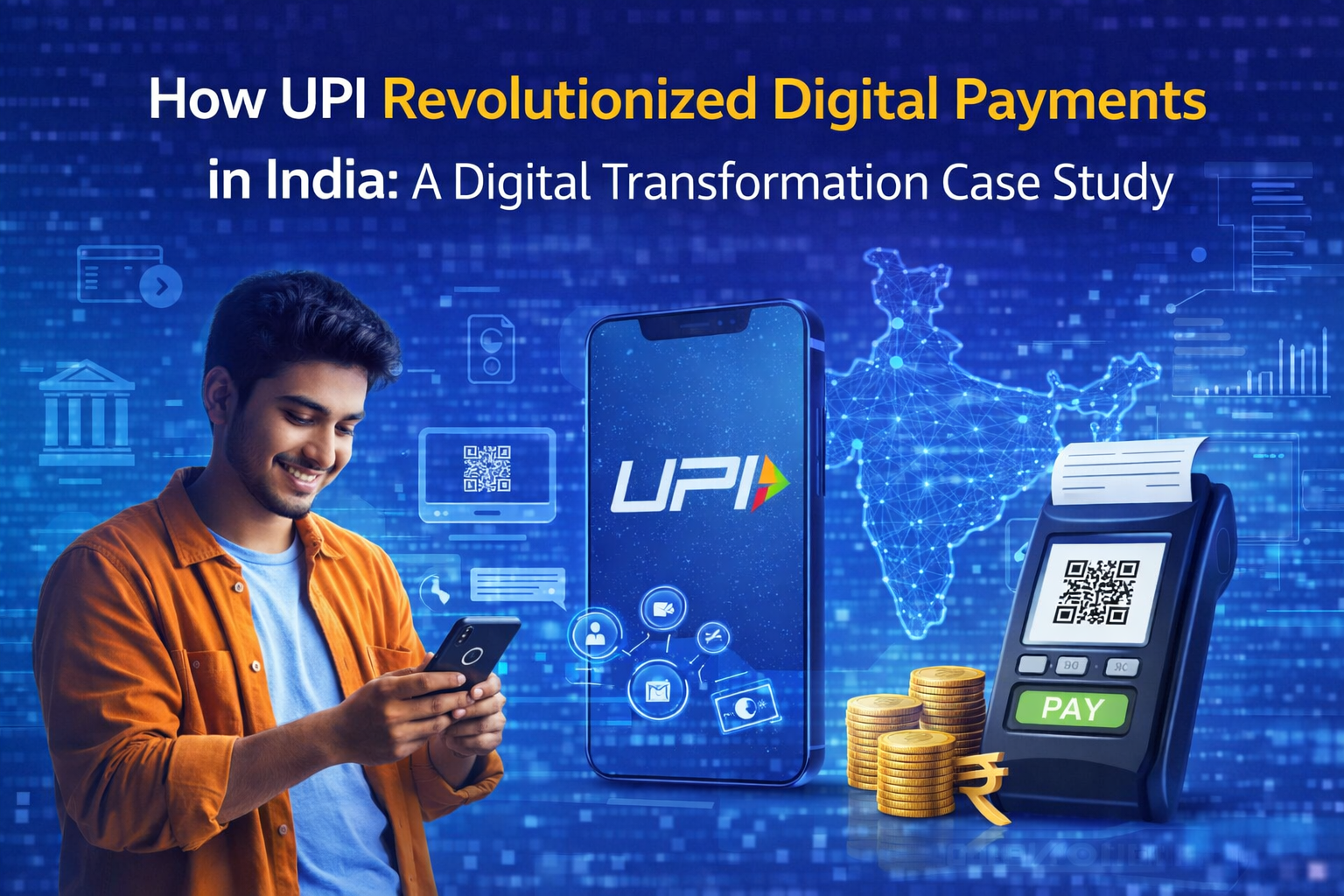
How UPI Revolutionized Digital Payments in India: A Digital Transformation Case Study
India’s digital transformation journey has become a benchmark for nations around the world, and one of the most remarkable examples of this progress is the rise of the Unified Payments Interface (UPI). What began as a government-backed initiative to modernize digital transactions has now evolved into one of the most successful financial technologies globally.
Today, UPI powers billions of transactions every month, making India one of the world’s leading digital payment economies. But beyond convenience, UPI represents something much larger—it is a case study in how technology, government strategy, and digital infrastructure can come together to transform a nation.
What is UPI?
Unified Payments Interface (UPI) is an instant real-time payment system developed by the National Payments Corporation of India (NPCI) and regulated by the Reserve Bank of India.
Launched in 2016, UPI was designed to enable users to transfer money instantly between bank accounts using mobile devices, without requiring lengthy bank details or complicated processes.
Instead of remembering account numbers and IFSC codes, users simply need a Virtual Payment Address (VPA), mobile number, or QR code to send and receive payments.
This innovation simplified digital transactions for millions and laid the foundation for India’s cashless economy.
The Need for Digital Payment Transformation in India
Before UPI, digital payments in India faced multiple challenges. Traditional banking transfers were time-consuming, card penetration was limited, and many citizens relied heavily on cash for daily transactions.
Digital wallets existed, but they required pre-loading money and often lacked interoperability. For many users, digital transactions felt inconvenient and inaccessible.
India needed a system that was:
- Instant
- Secure
- Easy to use
- Scalable for millions
- Accessible to both urban and rural populations
UPI was developed as the answer to this challenge.
How UPI Revolutionized Digital Payments in India
UPI transformed India’s financial ecosystem by making digital payments simple, fast, and universally accessible.
With a smartphone and bank account, users could instantly:
- Transfer money to anyone
- Pay merchants using QR codes
- Receive payments directly
- Link multiple bank accounts into one app
This ease of use removed friction from digital adoption and encouraged millions of first-time users to embrace online payments.
The result was not just convenience—it was a behavioral shift in how India handles money.
Government’s Role in UPI Success
One of the biggest reasons behind UPI’s success is strong government support and strategic implementation.
The Indian government promoted digital adoption through initiatives such as:
- Digital India Mission
- Cashless Economy Campaigns
- Demonetization Push in 2016
- Financial Inclusion Programs
These initiatives created urgency and awareness around digital payments, accelerating UPI adoption nationwide.
Government support ensured that digital infrastructure and public awareness grew together.
Impact of UPI on India’s Economy
UPI’s impact extends far beyond payments. It has reshaped India’s economy in several ways.
Financial Inclusion
Millions of people who previously had limited access to banking services can now transact digitally through mobile apps.
Small Business Empowerment
Street vendors, local shops, and micro-businesses can accept digital payments instantly without investing in expensive payment infrastructure.
Reduced Cash Dependency
UPI has reduced the economy’s dependence on physical cash, improving transparency and efficiency.
Boost to Digital Commerce
E-commerce, online subscriptions, and service-based businesses have all benefited from frictionless payment systems.
Why UPI is a Global Benchmark in Digital Transformation
Countries across the globe are studying India’s UPI model because it demonstrates how digital public infrastructure can create large-scale impact.
UPI succeeded because it was:
- Built for scale
- Easy to use
- Open to innovation
- Supported by government and private sector collaboration
Its architecture proves that digital transformation is not only about building technology—it is about creating ecosystems that people actually use.
Key Lessons from UPI’s Success
Businesses and governments can learn valuable lessons from the UPI model:
Focus on User Simplicity
Technology succeeds when it is easy to understand and accessible.
Build for Scale
Infrastructure must be capable of supporting massive adoption.
Encourage Collaboration
UPI succeeded through collaboration between regulators, banks, fintechs, and developers.
Prioritize Accessibility
Digital systems must work for all demographics, not just tech-savvy users.
Conclusion
UPI is more than a payment platform—it is a symbol of India’s digital transformation success.
It has revolutionized digital payments in India by making transactions faster, simpler, and more accessible for millions. More importantly, it demonstrates how well-executed digital infrastructure can transform citizen behavior, boost economic participation, and strengthen national systems.
As India continues to innovate, UPI stands as proof that digital transformation, when done right, can create lasting impact at scale.
At DigitalCorn, we help organizations build scalable digital solutions inspired by transformative systems like UPI—leveraging AI, automation, and user-first design to create platforms that truly deliver impact.
STAY IN THE LOOP